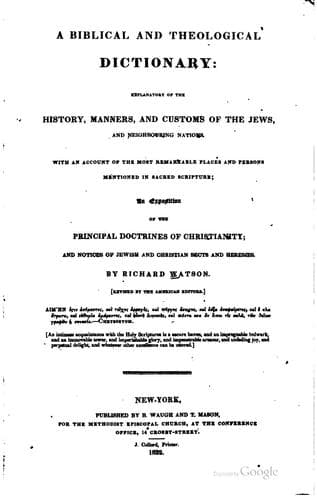
A Biblical and Theological Dictionary: explanatory of the history, manners, and customs of the Jews, and neighbouring nationsWatson, Richard
Religion
A Biblical and Theological Dictionary: explanatory of the history, manners, and customs of the Jews, and neighbouring nations
Watson, Richard
Bible -- Dictionaries; Theology -- Dictionaries
The _wild ass_, called PARA, is probably the _onager_ of the ancients.
It is taller and a much more dignified animal than the common or
domestic ass; its legs are more elegantly shaped; and it bears its head
higher. It is peculiarly distinguished by a dusky woolly mane, long
erect ears, and a forehead highly arched. The colour of the hair, in
general, is of a silvery white. These animals associate in herds, under
a leader, and are very shy. They inhabit the mountainous regions and
desert parts of Tartary, Persia, &c. Anciently they were likewise found
in Lycaonia, Phrygia, Mesopotamia, and Arabia Deserta. They are
remarkably wild; and Job, xxxix, 5–8, describes the liberty they enjoy,
the place of their retreat, their manners, and wild, impetuous, and
untamable spirit. “Vain man would be wise, though he be born a wild
ass’s colt,” Job xi, 12; עיר פרא, “ass colt,” not “ass’s colt;” יר being
in apposition with פרא, and not in government. The whole is a proverbial
expression, denoting extreme perversity and ferocity, and repeatedly
alluded to in the Old Testament. Thus, Gen. xvi, 12, it is prophesied of
Ishmael that he should be פרא אדם, a wild ass man; rough, untaught, and
libertine as a wild ass. So Hosea, xiii, 15; “He (Ephraim) hath _run
wild_ (literally _assified_ himself) amidst the braying monsters.” So
again, Hosea viii, 9, the very same character is given of Ephraim, who
is called “a solitary wild ass by himself,” or perhaps a solitary wild
ass of the _desert_; for the original will bear to be so rendered. This
proverbial expression has descended among the Arabians to the present
day, who still employ, as Schultens has remarked, the expressions, “the
ass of the desert,” or “the wild ass,” to describe an obstinate,
indocile, and contumacious person. The Prophet Isaiah, xxxii, 14,
describes great desolation by saying that “the wild asses shall rejoice
where a city stood.” There is another kind of ass called, אתון. Abraham
had ATONOTH, Gen. xii, 16; Balaam rode on an ATON, Num. xxii, 23. We
find from 1 Chron. xxvii, 30, that David had an officer expressly
appointed to superintend his ATONOTH; not his ordinary asses, but those
of a nobler race; which implies at least equal dignity in this officer
to his colleagues mentioned with him. This notion of the ATON gives also
a spirit to the history of Saul, who, when his father’s ATONOTH were
lost, was at no little pains to seek them; moreover, as beside being
valuable, they were _uncommon_, he might the more readily hear of them
if they had been noticed or taken up by any one; and this leads to the
true interpretation of the servant’s proposed application to Samuel,
verse 6, as though he said, “In his office of magistracy this honourable
man may have heard of these strayed rarities, and secured them;
peradventure he can direct us.”
Public-domain text, read in full here on John Shaqi.
Reviews
Reviews
No reviews yet
Be the first to share your thoughts on this work.
Elsewhere in the archive
Join the Discussion
Join the discussion
Sign in to leave a comment or review.
Sign InorCreate an account