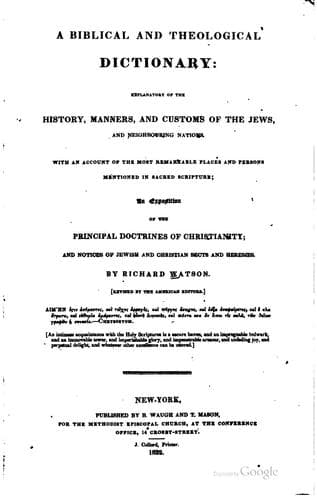
A Biblical and Theological Dictionary: explanatory of the history, manners, and customs of the Jews, and neighbouring nationsWatson, Richard
Religion
A Biblical and Theological Dictionary: explanatory of the history, manners, and customs of the Jews, and neighbouring nations
Watson, Richard
Bible -- Dictionaries; Theology -- Dictionaries
ASSIDEANS, by some named Chasideans, from _chasidim_, “merciful, pious.”
They were a kind of religious society among the Jews, whose chief and
distinguishing character was, to maintain the honour of the temple, and
observe punctually the traditions of the elders. They were therefore not
only content to pay the usual tribute for the maintenance of the house
of God, but charged themselves with farther expense upon that account;
for every day, except that of the great expiation, they sacrificed a
lamb, in addition to the daily oblation, which was called the sin
offering of the Assideans. They practised greater hardships and
mortifications than others; and their common oath was, “By the temple;”
for which our Saviour reproves the Pharisees, who had learned that oath
of them, Matt. xxiii, 16. From this sect the Pharisees sprung. The
Assideans are represented as a numerous sect, distinguished by its
valour, as well as by its zeal for the law, 1 Mac. ii, 42. A company of
them resorted to Mattathias, to fight for the law of God, and the
liberties of their country. This sect arose either during the captivity,
or soon after the restoration, of the Jews; and were probably in the
commencement, and long afterward, a truly pious part of the nation; but
they at length became superstitious.
ASSURANCE. The sense in which this term is used theologically is that of
a firm persuasion of our being in a state of salvation. The doctrine
itself has been matter of dispute among divines, and when considered as
implying not only that we are now accepted of God through Christ, but
that we shall be finally saved, or when it is so taken as to deny a
state of salvation to those who are not so assured as to be free from
all doubt, it is in many views questionable. Assurance of final
salvation must stand or fall with the doctrine of personal unconditional
election, and is chiefly held by divines of the Calvinistic school; and
that nothing is an evidence of a state of present salvation but so
entire a persuasion as amounts to assurance in the strongest sense,
might be denied upon the ground that degrees of grace, of real saving
grace, are undoubtedly mentioned in Scripture. Assurance, however, is
spoken of in the New Testament, and stands prominent as one of the
leading doctrines of religious experience. We have “full assurance of
understanding;” that is a perfect knowledge and entire persuasion of the
truth of the doctrine of Christ. The “assurance of faith,” in Hebrews
ix, 22, is an entire trust in the sacrifice and priestly office of
Christ. The “assurance of hope,” mentioned in Hebrews vi, 11, relates to
the heavenly inheritance, and must necessarily imply a full persuasion
that we are “the children of God,” and therefore “heirs of his glory;”
and from this passage it must certainly be concluded that such an
assurance is what every Christian ought to aim at, and that it is
attainable. This, however, does not exclude occasional doubt and
Public-domain text, read in full here on John Shaqi.
Reviews
Reviews
No reviews yet
Be the first to share your thoughts on this work.
Elsewhere in the archive
Join the Discussion
Join the discussion
Sign in to leave a comment or review.
Sign InorCreate an account