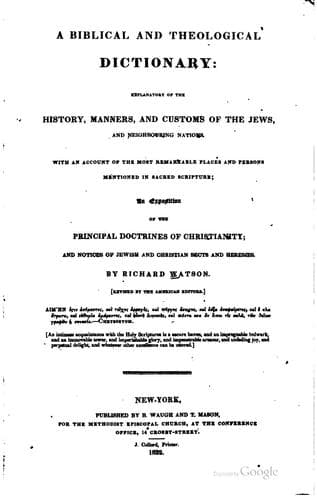
A Biblical and Theological Dictionary: explanatory of the history, manners, and customs of the Jews, and neighbouring nationsWatson, Richard
Religion
A Biblical and Theological Dictionary: explanatory of the history, manners, and customs of the Jews, and neighbouring nations
Watson, Richard
Bible -- Dictionaries; Theology -- Dictionaries
Thus we find that these _atonoth_ are mentioned in Scripture, only in
the possession of judges, patriarchs, and other great men; insomuch that
where these are there is dignity, either expressed or implied. They were
also a present for a prince; for Jacob presented Esau with twenty, Gen.
xxxii, 15. What then shall we say of the wealth of Job, who possessed a
thousand? Another word which is rendered “_wild ass_” by our
translators, Job xxxix, 5, is ORUD; which seems to be the same, that in
the Chaldee of Daniel, v, 21, is called _oredia_. Mr. Parkhurst supposes
that this word denotes _the brayer_, and that PARA and ORUD are only two
names for the same animal. But these names _may_ perhaps refer to
different races, though of the same species; so that a description of
the properties of one may apply to both, though not without some
variation.
Who sent out the _para_ free?
Or who hath loosed the bands of the _orud_?
Whose dwelling I have made the wilderness,
And the barren land (salt deserts) his resort:
The range of open mountains are his pasture,
And he searcheth after every green thing.
Gmelin observes that the _onager_ is very fond of salt. Whether the
“deserts” of the above text were salt marshes, or salt deserts, is of
very little consequence; the circumstance shows the correctness of the
Hebrew poet. In Daniel we read that Nebuchadnezzar dwelt with the
OREDIA. We need not suppose that he was banished to the deserts, but was
at most kept safely in an enclosure of his own park, where curious
animals were kept for state and pleasure. If this be correct, then the
ORUD was somewhat, at least, of a rarity at Babylon; and it might be of
a kind different from the PARA, as it is denoted by another name. May it
not be the _Gicquetei_ of Professor Pallas, the wild mule of Mongalia
which surpasses the _onager_ in size, beauty, and perhaps in swiftness.
Public-domain text, read in full here on John Shaqi.
Reviews
Reviews
No reviews yet
Be the first to share your thoughts on this work.
Elsewhere in the archive
Join the Discussion
Join the discussion
Sign in to leave a comment or review.
Sign InorCreate an account