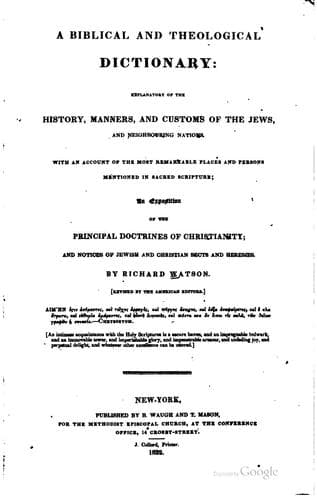
A Biblical and Theological Dictionary: explanatory of the history, manners, and customs of the Jews, and neighbouring nationsWatson, Richard
Religion
A Biblical and Theological Dictionary: explanatory of the history, manners, and customs of the Jews, and neighbouring nations
Watson, Richard
Bible -- Dictionaries; Theology -- Dictionaries
The first of these conclusions is sufficiently disproved by the
authority of Scripture, which exhibits justification as a blessing
attainable in this life, and represents it as actually experienced by
true believers. “Therefore being justified by faith.” “There is _now_ no
condemnation to them who are in Christ Jesus.” “Whosoever believeth is
justified from all things,” &c. The quotations might be multiplied, but
these are decisive. The notion that though an act of forgiveness may
take place, we are unable to ascertain a fact so important to us, is
also irreconcilable with many scriptures in which the writers of the New
Testament speak of an experience, not confined personally to themselves,
or to those Christians who were endowed with spiritual gifts, but common
to all Christians. “Being justified by faith we have _peace_ with God.”
“We joy in God, by whom we have received the _reconciliation_.” “Being
reconciled unto God by the death of his Son.” “We have not received the
spirit of bondage again unto fear, but the spirit of adoption, by which
we cry, Abba, Father.” To these may be added innumerable passages which
express the comfort, the confidence, and the joy of Christians; their
“friendship” with God; their “access” to him; their entire union and
delightful intercourse with him; and their absolute confidence in the
success of their prayers. All such passages are perfectly consistent
with deep humility, and self-diffidence; but they are irreconcilable
with a state of hostility between the parties, and with an unascertained
and only hoped-for restoration of friendship and favour.
An assurance, therefore, that the sins which are felt to “be a burden
intolerable” are forgiven, and that the ground of that apprehension of
future punishment which causes the penitent to “_bewail_ his manifold
sins,” is taken away by restoration to the favour of the offended God,
must be allowed, or nothing would be more incongruous and impossible
than the comfort, the peace, the rejoicing of spirit, which in the
Scriptures are attributed to believers.
Few Christians of evangelical views have, therefore, denied the
possibility of our becoming assured of the favour of God in a sufficient
degree to give substantial comfort to the mind. Their differences have
rather respected the means by which the contrite become assured of that
change in their relation to Almighty God, whom they have offended, which
in Scripture is expressed by the term justification. The question has
been, (where the notion of an assurance of eternal salvation has not
been under discussion,) by what means the assurance of the divine favour
is conveyed to the mind. Some have concluded that we obtain it by
_inference_, others by the _direct testimony_ of the Holy Spirit to the
mind. See HOLY SPIRIT.
Public-domain text, read in full here on John Shaqi.
Reviews
Reviews
No reviews yet
Be the first to share your thoughts on this work.
Elsewhere in the archive
Join the Discussion
Join the discussion
Sign in to leave a comment or review.
Sign InorCreate an account