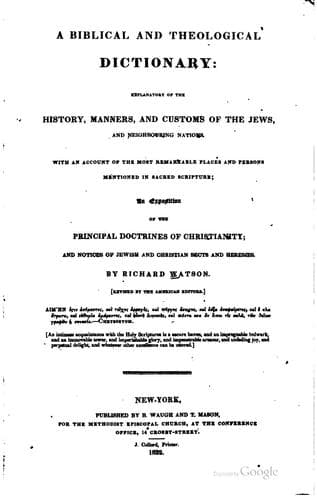
A Biblical and Theological Dictionary: explanatory of the history, manners, and customs of the Jews, and neighbouring nationsWatson, Richard
Religion
A Biblical and Theological Dictionary: explanatory of the history, manners, and customs of the Jews, and neighbouring nations
Watson, Richard
Bible -- Dictionaries; Theology -- Dictionaries
ASSYRIA, a kingdom of Asia, of the extent, origin, and duration of which
very different accounts have been given by ancient writers. Ctesias and
Diodorus Siculus affirm, that the Assyrian monarchy, under Ninus and
Semiramis, comprehended the greater part of the known world: but, if
this had been the case, it is not likely that Homer and Herodotus would
have omitted a fact so remarkable. The sacred records intimate that none
of the ancient states or kingdoms were of considerable extent; for
neither Chederlaomer, nor any of the neighbouring princes, were
tributary or subject to Assyria; and “we find nothing,” says Playfair,
“of the greatness or power of this kingdom in the history of the judges
and succeeding kings of Israel, though the latter kingdom was oppressed
and enslaved by many different powers in that period.” It is therefore
highly probable that Assyria was originally of small extent. According
to Ptolemy, this country was bounded on the north by part of Armenia and
Mount Niphates; on the west by the Tigris; on the south by Susiana; and
on the east by part of Media and the mountains Choatra and Zagros. Of
the origin, revolutions, and termination of Assyria, properly so called,
and distinguished from the grand monarchy which afterward bore this
appellation, the following account is given by Mr. Playfair, as the most
probable:--“The founder of it was Ashur, the second son of Shem, who
departed from Shinar, upon the usurpation of Nimrod, at the head of a
large body of adventurers, and laid the foundations of Nineveh, where he
resided, and erected a new kingdom, called Assyria, after his name, Gen.
x, 11. These events happened not long after Nimrod had established the
Chaldean monarchy, and fixed his residence at Babylon; but it does not
appear that Nimrod reigned in Assyria. The kingdoms of Assyria and
Babylon were originally distinct and separate, Micah v, 6; and in this
state they remained until Ninus conquered Babylon, and made it tributary
to the Assyrian empire. Ninus, the successor of Ashur, Gen. x, 11,
seized on Chaldea after the death of Nimrod, and united the kingdoms of
Assyria and Babylon. This great prince is said to have subdued Asia,
Persia, Media, Egypt, &c. If he did so, the effects of his conquests
were of no long duration; for, in the days of Abraham, we do not find
that any of the neighbouring kingdoms were subject to Assyria. Ninus was
succeeded by Semiramis, a princess bold, enterprising, and fortunate; of
whose adventures and exploits many fabulous relations have been
recorded. Playfair is of opinion that there were two princesses of this
name, who flourished at different periods: one, the consort of Ninus;
and another, who lived five generations before Nitocris, queen of
Nebuchadnezzar. Of the successors of Ninus and Semiramis nothing certain
is recorded. The last of the ancient Assyrian kings was Sardanapalus,
who was besieged in his capital by Arbaces, governor of Media, in
concurrence with the Babylonians.
Public-domain text, read in full here on John Shaqi.
Reviews
Reviews
No reviews yet
Be the first to share your thoughts on this work.
Elsewhere in the archive
Join the Discussion
Join the discussion
Sign in to leave a comment or review.
Sign InorCreate an account