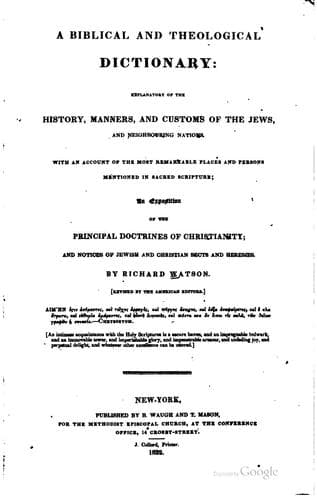
A Biblical and Theological Dictionary: explanatory of the history, manners, and customs of the Jews, and neighbouring nationsWatson, Richard
Religion
A Biblical and Theological Dictionary: explanatory of the history, manners, and customs of the Jews, and neighbouring nations
Watson, Richard
Bible -- Dictionaries; Theology -- Dictionaries
ASTROLOGY, the art of foretelling future events, from the aspects,
positions, and influences of the heavenly bodies. The word is compounded
of ἀϛὴρ star, and λόγος, discourse; whence, in the literal sense of the
term, astrology should signify no more than the doctrine or science of
the stars. Astrology judiciary, or judicial, is what we commonly call
simple astrology, or that which pretends to foretel mortal events, even
those which have a dependence on the free will and agency of man; as if
they were directed by the stars. This art, which owed its origin to the
practice of knavery on credulity, is now universally exploded by the
intelligent part of mankind. Judicial astrology is commonly said to have
been invented in Chaldea, and thence transmitted to the Egyptians,
Greeks, and Romans; though some will have it of Egyptian origin, and
ascribe the invention to Cham. But we derive it from the Arabians. The
Chaldeans, and the Egyptians, and indeed almost all the nations of
antiquity, were infatuated with the chimæras of astrology. It originated
in the notion, that the stars have an influence, either beneficial or
malignant, upon the affairs of men, which may be discovered, and made
the ground of certain prediction, in particular cases; and the whole art
consisted in applying astronomical observations to this fanciful
purpose. Diodorus Siculus relates, that the Chaldeans learned these arts
from the Egyptians; and he would not have made this assertion, if there
had not been at least a general tradition that they were practised from
the earliest times in Egypt. The system was, in those remote ages,
intimately connected with Sabaism, or the worship of the stars as
divinities; but whether it emanates from idolatry or fatality, it denies
God and his providence, and is therefore condemned in the Scriptures,
and ranked with practices the most offensive and provoking to the Divine
Majesty.
ASTYAGES, otherwise, Cyaxares, king of the Medes, and successor to
Phraortes. He reigned forty years, and died A. M. 3409. He was father to
Astyages, otherwise called Darius the Mede. He had two daughters,
Mandane and Amyit: Mandane married Cambyses, the Persian, and was the
mother of Cyrus; Amyit married Nebuchadnezzar, the son of Nabopolassar,
and was the mother of Evilmerodach.
ASTYAGES, otherwise called Ahasuerus in the Greek, Dan. ix, 1, or
Cyaxares in Xenophon, or Apandus in Ctesias, was appointed by his father
Cyaxares governor of Media, and sent with Nabopolassar, king of Babylon,
against Saracus, otherwise called Chynaladanus, king of Assyria. These
two princes besieged Saracus in Nineveh, took the city, and dismembered
the Assyrian empire. Astyages was with Cyrus at the conquest of Babylon,
and succeeded Belshazzar, king of the Chaldeans, as is expressly
mentioned in Daniel, v, 30, 31, A. M. 3447. After his death Cyrus
succeeded him, A. M. 3456.
Public-domain text, read in full here on John Shaqi.
Reviews
Reviews
No reviews yet
Be the first to share your thoughts on this work.
Elsewhere in the archive
Join the Discussion
Join the discussion
Sign in to leave a comment or review.
Sign InorCreate an account