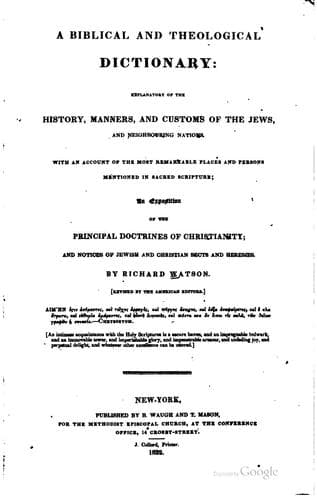
A Biblical and Theological Dictionary: explanatory of the history, manners, and customs of the Jews, and neighbouring nationsWatson, Richard
Religion
A Biblical and Theological Dictionary: explanatory of the history, manners, and customs of the Jews, and neighbouring nations
Watson, Richard
Bible -- Dictionaries; Theology -- Dictionaries
xlvi, 2; “and therefore we cannot err,” says Sir Isaac Newton, “above a
year or two, if we refer the destruction of Nineveh, and fall of the
Assyrian empire, to the third year, of Jehoiakim,” or the hundred and
fortieth, or, according to Blair, the hundred and forty-first year of
Nabonassar; that is, the year B. C. 607.
Of the government, laws, religion, learning, customs, &c, of the ancient
Assyrians, nothing absolutely certain is recorded. Their kingdom was at
first small, and subsisted for several ages under hereditary chiefs; and
their government was simple. Afterward, when they rose to the sublimity
of empire, their government seems to have been despotic, and the empire
hereditary. Their laws were probably few, and depended upon the mere
will of the prince. To Ninus we may ascribe the division of the Assyrian
empire into provinces and governments; for we find that this institution
was fully established in the reigns of Semiramis and her successors. The
people were distributed into a certain number of tribes; and their
occupations or professions were hereditary. The Assyrians had several
distinct councils, and several tribunals for the regulation of public
affairs. Of councils there were three, which were created by the body of
the people, and who governed the state in conjunction with the
sovereign. The first consisted of officers who had retired from military
employments; the second, of the nobility; and the third, of the old men.
The sovereigns also had three tribunals, whose province it was to watch
over the conduct of the people. The Assyrians have been competitors with
the Egyptians for the honour of having invented alphabetic writing. It
appears, from the few remains now extant of the writing of these ancient
nations, that their letters had a great affinity with each other. They
much resembled one another in shape; and they ranged them in the same
manner, from right to left.
Public-domain text, read in full here on John Shaqi.
Reviews
Reviews
No reviews yet
Be the first to share your thoughts on this work.
Elsewhere in the archive
Join the Discussion
Join the discussion
Sign in to leave a comment or review.
Sign InorCreate an account