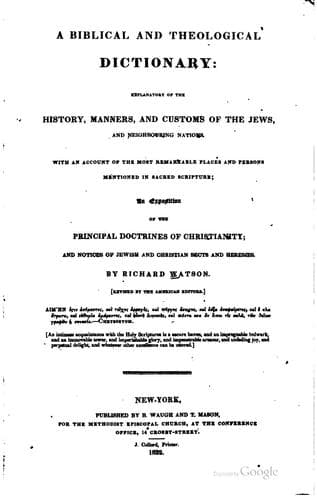
A Biblical and Theological Dictionary: explanatory of the history, manners, and customs of the Jews, and neighbouring nationsWatson, Richard
Religion
A Biblical and Theological Dictionary: explanatory of the history, manners, and customs of the Jews, and neighbouring nations
Watson, Richard
Bible -- Dictionaries; Theology -- Dictionaries
ATHEIST, in the strict and proper sense of the word, is one who does not
believe in the existence of a God, or who owns no being superior to
nature. It is compounded of the two terms, α negative, and Θεὸς, God,
signifying _without God_. Atheists have been also known by the name
infidels; but the word infidel is now commonly used to distinguish a
more numerous party, and is become almost synonymous with Deist. He who
disbelieves the existence of a God, as an infinite, intelligent, and a
moral agent, is a direct or speculative Atheist; he who confesses a
Deity and providence in words, but denies them in his life and actions,
is a practical Atheist. That Atheism existed in some sense before the
flood, may be suspected from what we read in Scripture, as well as from
Heathen tradition; and it is not very unreasonable to suppose, that the
deluge was partly intended to evince to the world a heavenly power, as
Lord of the universe, and superior to the visible system of nature. This
was at least a happy consequence of that fatal catastrophe; for, as it
is observed by Dean Sherlock, “The universal deluge, and the confusion
of languages, had so abundantly convinced mankind of a divine power and
providence, that there was no such creature as an Atheist, till their
ridiculous idolatries had tempted some men of wit and thought, rather to
own no God than such as the Heathens worshipped.”
Atheistical principles were long nourished and cherished in Greece, and
especially among the atomical, peripatetic, and skeptical philosophers;
and hence some have ascribed the origin of Atheism to the philosophy of
Greece. This is true, if they mean that species of refined Atheism,
which contrives any impious scheme of principles to account for the
origin of the world, without a divine being. For though there may have
been in former ages, and in other countries, some persons irreligious in
principle as well as in practice, yet we know of none who, forming a
philosophical scheme of impiety, became a sect, and erected colleges of
Atheistical learning, till the arrogant and enterprising genius of
Greece undertook that detestable work. Carrying their presumptuous and
ungoverned speculations into the very essence of the divinity, at first
they doubted, and at length denied, the existence of a first cause
independent of nature and of a providence that superintends its laws,
and governs the concerns of mankind. These principles, with the other
improvements of Greece, were transferred to Rome; and, excepting in
Italy, we hear little of Atheism, for many ages after the Christian æra.
“For some ages before the Reformation,” says Archbishop Tillotson,
“Atheism was confined to Italy, and had its chief residence at Rome.
But, in this last age, Atheism has travelled over the Alps and infected
France, and now of late it hath crossed the seas, and invaded our
nation, and hath prevailed to amazement.” However, to Tillotson, and
Public-domain text, read in full here on John Shaqi.
Reviews
Reviews
No reviews yet
Be the first to share your thoughts on this work.
Elsewhere in the archive
Join the Discussion
Join the discussion
Sign in to leave a comment or review.
Sign InorCreate an account