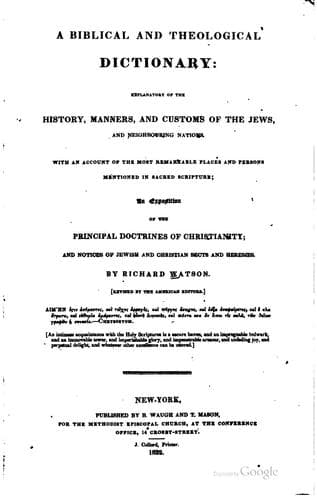
A Biblical and Theological Dictionary: explanatory of the history, manners, and customs of the Jews, and neighbouring nationsWatson, Richard
Religion
A Biblical and Theological Dictionary: explanatory of the history, manners, and customs of the Jews, and neighbouring nations
Watson, Richard
Bible -- Dictionaries; Theology -- Dictionaries
other able writers, we owe its suppression in this country; for they
pressed it down with a weight of sound argument, from which it has never
been able to raise itself. For although in our time, in France and
Germany a subtle Atheism was revived, and spread its unhallowed and
destructive influence for many years throughout the Continent, it made
but little progress in this better-instructed nation.
Atheism, in its primary sense, comprehends, or at least goes beyond,
every heresy in the world; for it professes to acknowledge no religion,
true or false. The two leading hypotheses which have prevailed, among
Atheists, respecting this world and its origin, are, that of Ocellus
Lucanus, adopted and improved by Aristotle, that it was eternal; and
that of Epicurus, that it was formed by a fortuitous concourse of atoms.
“That the soul is material and mortal, Christianity an imposture, the
Scripture a forgery, the worship of God superstition, hell a fable, and
heaven a dream, our life without providence, and our death without hope,
like that of asses and dogs, are part of the glorious gospel of our
modern Atheists.”
The being of a God may be proved from the marks of design, and from the
order and beauty visible in the world; from universal consent; from the
relation of cause and effect; from internal consciousness; and from the
necessity of a final as well as an efficient cause.
Of all the false doctrines and foolish opinions that ever infested the
mind of man, nothing can possibly equal that of Atheism, which is such a
monstrous contradiction of all evidence, to all the powers of
understanding, and the dictates of common sense, that it may be well
questioned whether any man can really fall into it by a deliberate use
of his judgment. All nature so clearly points out, and so loudly
proclaims, a Creator of infinite power, wisdom, and goodness, that
whoever hears not its voice, and sees not its proofs, may well be
thought wilfully deaf, and obstinately blind. If it be evident,
self-evident to every man of thought, that there can be no effect
without a cause, what shall we say of that manifold combination of
effects, that series of operations, that system of wonders, which fill
the universe, which present themselves to all our perceptions, and
strike our minds and our senses on every side? Every faculty, every
object of every faculty, demonstrates a Deity. The meanest insect we can
see, the minutest and most contemptible weed we can tread upon, is
really sufficient to confound Atheism, and baffle all its pretensions.
How much more that astonishing variety and multiplicity of God’s works
with which we are continually surrounded! Let any man survey the face of
the earth, or lift up his eyes to the firmament; let him consider the
nature and instincts of brute animals, and afterward look into the
operations of his own mind, and will he presume to say or suppose that
all the objects he meets with are nothing more than the result of
Public-domain text, read in full here on John Shaqi.
Reviews
Reviews
No reviews yet
Be the first to share your thoughts on this work.
Elsewhere in the archive
Join the Discussion
Join the discussion
Sign in to leave a comment or review.
Sign InorCreate an account