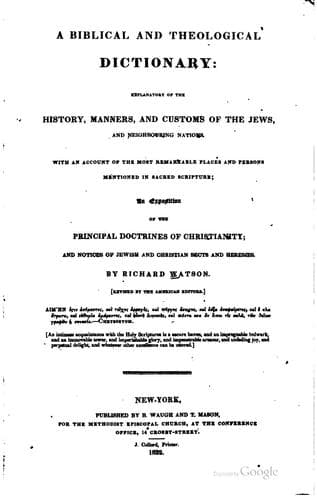
A Biblical and Theological Dictionary: explanatory of the history, manners, and customs of the Jews, and neighbouring nationsWatson, Richard
Religion
A Biblical and Theological Dictionary: explanatory of the history, manners, and customs of the Jews, and neighbouring nations
Watson, Richard
Bible -- Dictionaries; Theology -- Dictionaries
Dr. Samuel Clarke, in his “Demonstration of the Being of a God,” says,
that Atheism arises either from stupid ignorance, or from corruption of
principles and manners, or from the reasonings of false philosophy; and
he adds, that the latter, who are the only Atheistical persons capable
of being reasoned with at all, must of necessity own that, supposing it
cannot be proved to be true, yet it is a thing very desirable, and which
any wise man would wish to be true, for the great benefit and happiness
of man, that there was a God, an intelligent and wise, a just and good
Being, to govern the world. Whatever hypothesis these men can possibly
frame, whatever argument they can invent, by which they would exclude
God and providence out of the world; that very argument or hypothesis,
will of necessity lead them to this concession. If they argue, that our
notion of God arises not from nature and reason, but from the art and
contrivance of politicians; that argument itself forces them to confess,
that it is manifestly for the interest of human society, that it should
be believed there is a God. If they suppose that the world was made by
chance, and is every moment subject to be destroyed by chance again; no
man can be so absurd as to contend, that it is as comfortable and
desirable to live in such an uncertain state of things, and so
continually liable to ruin, without any hope of renovation, as in a
world that is under the preservation and conduct of a powerful, wise,
and good God. If they argue against the being of God, from the faults
and defects which they imagine they can find in the frame and
constitution of the visible and material world; this supposition obliges
them to acknowledge that it would have been better the world had been
made by an intelligent and wise Being, who might have prevented all
faults and imperfections. If they argue against providence, from the
faultiness and inequality which they think they discover in the
management of the moral world; this is a plain confession, that it is a
thing more fit and desirable in itself, that the world should be
governed by a just and good Being, than by mere chance or unintelligent
necessity. Lastly, if they suppose the world to be eternally and
necessarily self-existent, and consequently that every thing in it is
established by a blind and eternal fatality; no rational man can at the
same time deny, but that liberty and choice, or a free power of acting,
is a more eligible state, than to be determined thus in all our actions,
as a stone is to move, downward, by an absolute and inevitable fate. In
a word, which way soever they turn themselves, and whatever hypothesis
they make, concerning the original and frame of things, nothing is so
certain and undeniable, as that man, considered without the protection
and conduct of a superior Being, is in a far worse case than upon
supposition of the being and government of God, and of men’s being under
his peculiar conduct, protection, and favour.
Public-domain text, read in full here on John Shaqi.
Reviews
Reviews
No reviews yet
Be the first to share your thoughts on this work.
Elsewhere in the archive
Join the Discussion
Join the discussion
Sign in to leave a comment or review.
Sign InorCreate an account