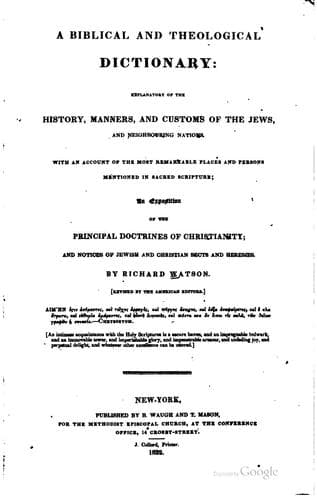
A Biblical and Theological Dictionary: explanatory of the history, manners, and customs of the Jews, and neighbouring nationsWatson, Richard
Religion
A Biblical and Theological Dictionary: explanatory of the history, manners, and customs of the Jews, and neighbouring nations
Watson, Richard
Bible -- Dictionaries; Theology -- Dictionaries
unaccountable accidents and blind chance? Can he possibly conceive that
such wonderful order should spring out of confusion? or that such
perfect beauty should be ever formed by the fortuitous operations of
unconscious, unactive particles of matter? As well, nay better, and more
easily, might he suppose that an earthquake might happen to build towns
and cities; or the materials carried down by a flood fit themselves up
without hands into a regular fleet. For what are towns, cities, or
fleets, in comparison of the vast and amazing fabric of the universe! In
short, Atheism offers such violence to all our faculties, that it seems
scarce credible it should ever really find any place in the human
understanding. Atheism is unreasonable, because it gives no tolerable
account of the existence of the world. This is one of the greatest
difficulties with which the Atheist has to contend. For he must suppose
either that the world is eternal, or that it was formed by chance and a
fortuitous concourse of the parts of matter. That the world had a
beginning, is evident from universal tradition, and the most ancient
history that exists; from there being no memorials of any actions
performed previously to the time assigned in that history as the æra of
the creation; from the origin of learning and arts, and the liability of
the parts of matter to decay. That the world was not produced by chance,
is also evident. Nothing can be more unreasonable than to ascribe to
chance an effect which appears with all the characters of a wise design
and contrivance. Will chance fit means to ends, even in ten thousand
instances, and not fail in a single one? How often might a man, after
shaking a set of letters in a bag, throw them on the ground, before they
would become an exact poem, or form a good discourse in prose? In short,
the arguments in proof of Deity are so numerous, and at the same time so
obvious to a thinking mind, that to waste time in disputing with an
Atheist, is approaching too much toward that irrationality, which may be
considered as one of the most striking characteristics of the sect.
The more noted Atheist, since the Reformation, are Machiavel, Spinoza,
Hobbes, Blount, and Vanini. To these may be added Hume, and Voltaire the
corypheus of the sect, and the great nursing father of that swarm of
them which has appeared in these last days.
Public-domain text, read in full here on John Shaqi.
Reviews
Reviews
No reviews yet
Be the first to share your thoughts on this work.
Elsewhere in the archive
Join the Discussion
Join the discussion
Sign in to leave a comment or review.
Sign InorCreate an account