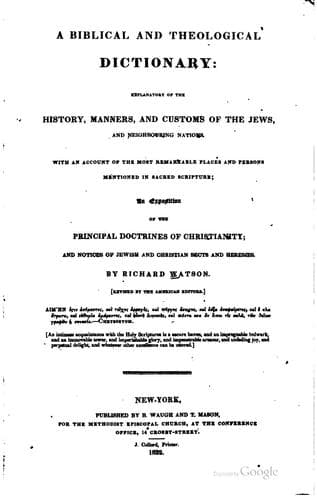
A Biblical and Theological Dictionary: explanatory of the history, manners, and customs of the Jews, and neighbouring nationsWatson, Richard
Religion
A Biblical and Theological Dictionary: explanatory of the history, manners, and customs of the Jews, and neighbouring nations
Watson, Richard
Bible -- Dictionaries; Theology -- Dictionaries
mortal eye can approach, and yet is nigh unto the meanest of his
creatures; in whom we live, and move, and have our being.”
ATONEMENT, the satisfaction offered to divine justice by the death of
Christ for the sins of mankind, by virtue of which all true penitents
who believe in Christ are personally reconciled to God, are freed from
the penalty of their sins, and entitled to eternal life. The atonement
for sin made by the death of Christ, is represented in the Christian
system as the means by which mankind may be delivered from the awful
catastrophe of eternal death; from judicial inflictions of the
displeasure of a Governor, whose authority has been contemned, and whose
will has been resisted, which shall know no mitigation in their degree,
nor bound to their duration. This end it professes to accomplish by
means which, with respect to the Supreme Governor himself, preserve his
character from mistake, and maintain the authority of his government;
and with respect to man, give him the strongest possible reason for
hope, and render more favourable the condition of his earthly probation.
These are considerations which so manifestly show, from its own internal
constitution, the superlative importance and excellence of Christianity,
that it would be exceedingly criminal to overlook them.
How sin may be forgiven without leading to such misconceptions of the
divine character as would encourage disobedience, and thereby weaken the
influence of the divine government, must be considered as a problem of
very difficult solution. A government which admitted no forgiveness,
would sink the guilty to despair; a government which never punishes
offence, is a contradiction,--it cannot exist. Not to punish the guilty,
is to dissolve authority; to punish without mercy, is to destroy, and
where all are guilty, to make the destruction universal. That we cannot
sin with impunity, is a matter determined. The Ruler of the world is not
careless of the conduct of his creatures; for that penal consequences
are attached to the offence, is not a subject of argument, but is matter
of fact evident by daily observation of the events and circumstances of
the present life. It is a principle therefore already laid down, that
the authority of God must be preserved; but it ought to be remarked,
that in that kind of administration which restrains evil by penalty, and
encourages obedience by favour and hope, we and all moral creatures are
the interested parties, and not the divine Governor himself, whom,
because of his independent and all-sufficient nature, our transgressions
cannot injure. The reasons, therefore, which compel him to maintain his
authority do not terminate in himself. If he treats offenders with
severity, it is for our sake, and for the sake of the moral order of the
universe, to which sin, if encouraged by a negligent administration, or
by entire or frequent impunity, would be the source of endless disorder
Public-domain text, read in full here on John Shaqi.
Reviews
Reviews
No reviews yet
Be the first to share your thoughts on this work.
Elsewhere in the archive
Join the Discussion
Join the discussion
Sign in to leave a comment or review.
Sign InorCreate an account