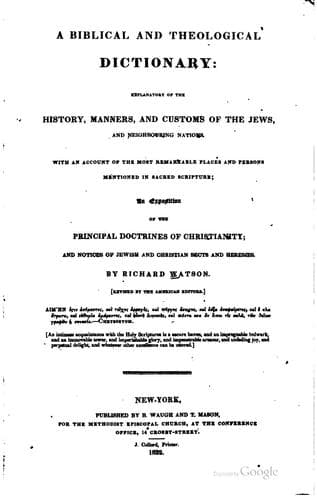
A Biblical and Theological Dictionary: explanatory of the history, manners, and customs of the Jews, and neighbouring nationsWatson, Richard
Religion
A Biblical and Theological Dictionary: explanatory of the history, manners, and customs of the Jews, and neighbouring nations
Watson, Richard
Bible -- Dictionaries; Theology -- Dictionaries
and misery; and if the granting of pardon to offence be strongly and
even severely guarded, so that no less a satisfaction could be accepted
than the death of God’s own Son, we are to refer this to the moral
necessity of the case as arising out of the general welfare of
accountable creatures, liable to the deep evil of sin, and not to any
reluctance on the part of our Maker to forgive, much less to any thing
vindictive in his nature,--charges which have been most inconsiderately
and unfairly said to be implied in the doctrine of Christ’s vicarious
sufferings. If it then be true, that the release of offending man from
future punishment, and his restoration to the divine favour, ought, for
the interests of mankind themselves, and for the instruction and caution
of other beings, to be so bestowed, that no license shall be given to
offence;--that God himself, whilst he manifests his compassion, should
not appear less just, less holy, than he really is;--that his authority
should be felt to be as compelling, and that disobedience should as
truly, though not unconditionally, subject us to the deserved penalty,
as though no hope of forgiveness had been exhibited;--we ask, On what
scheme, save that which is developed in the New Testament, are these
necessary conditions provided for? Necessary they are, unless we contend
for a license and an impunity which shall annul all good government in
the universe, a point for which no reasonable man will contend; and if
so, then we must allow that there is strong internal evidence of the
truth of the doctrine of Scripture, when it makes the offer of pardon
consequent only upon the securities we have before mentioned. If it be
said, that sin may be pardoned in the exercise of the divine
prerogative, the reply is, that if this prerogative were exercised
toward a part of mankind only, the passing by of the rest would be with
difficulty reconciled to the divine character; and if the benefit were
extended to all, government would be at an end. This scheme of bringing
men within the exercise of a merciful prerogative, does not therefore
meet the obvious difficulty of the case; nor is it improved by confining
the act of grace only to repentant criminals. For in the immediate view
of danger, what offender, surrounded with the wreck of former
enjoyments, feeling the vanity of guilty pleasures, now past for ever,
and beholding the approach of the delayed penal visitation, but would
repent? Were the principle of granting pardon to repentance to regulate
human governments, every criminal would escape, and judicial forms would
become a subject for ridicule. Nor is it recognised by the divine Being
in his conduct to men in the present state, although in this world
punishments are not final and absolute. Repentance does not restore
health injured by intemperance; property, wasted by profusion; or
character, once stained by dishonourable practices. If repentance alone
could secure pardon, then all must be pardoned, and government
Public-domain text, read in full here on John Shaqi.
Reviews
Reviews
No reviews yet
Be the first to share your thoughts on this work.
Elsewhere in the archive
Join the Discussion
Join the discussion
Sign in to leave a comment or review.
Sign InorCreate an account