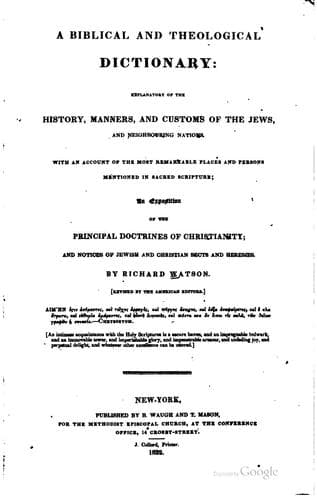
A Biblical and Theological Dictionary: explanatory of the history, manners, and customs of the Jews, and neighbouring nationsWatson, Richard
Religion
A Biblical and Theological Dictionary: explanatory of the history, manners, and customs of the Jews, and neighbouring nations
Watson, Richard
Bible -- Dictionaries; Theology -- Dictionaries
The passages that follow, plainly and distinctly declare the atoning
efficacy of Christ’s death: “Now once in the end of the world hath he
appeared to put away sin by the sacrifice of himself.” “Christ was once
offered to bear the sins of many; and unto them that look for him shall
he appear the second time without sin unto salvation,” Heb. ix, 26, 28.
“This man, after he had offered one sacrifice for sin, for ever sat down
on the right hand of God; for by one offering he hath perfected for ever
them that are sanctified,” Heb. x, 12. It is observable, that nothing
similar is said of the death of any other person, and that no such
efficacy is imputed to any other martyrdom. “While we were yet sinners
Christ died for us; much more then, being now justified by his blood, we
shall be saved from wrath through him: for if, when we were enemies, we
were reconciled to God by the death of his Son, much more, being
reconciled, we shall be saved by his life,” Rom. v, 8–10. The words,
“reconciled to God by the death of his Son,” show that his death had an
efficacy in our reconciliation; but reconciliation is only preparatory
to salvation. “He has reconciled us to his Father in his cross, and in
the body of his flesh through death,” Col. i, 20, 22. What is said of
reconciliation in these texts, is in some others spoken of
sanctification, which is also preparatory to salvation. “We are
sanctified,”--how? “by the offering of the body of Christ once for all,”
Heb. x, 10. In the same epistle, the blood of Jesus is called “the blood
of the covenant by which we are sanctified.” In these and many other
passages that occur in different parts of the New Testament, it is
therefore asserted that the death of Christ had an efficacy in the
procuring of human salvation. Such expressions are used concerning no
other person, and the death of no other person; and it is therefore
evident, that Christ’s death included something more than a confirmation
of his preaching; something more than a pattern of a holy and patient
martyrdom; something more than a necessary antecedent to his
resurrection, by which he gave a grand and clear proof of our
resurrection from the dead. Christ’s death was all these, but it was
something more. It was an atonement for the sins of mankind; and in this
way only it became the accomplishment of our eternal redemption. See DAY
OF EXPIATION.
Public-domain text, read in full here on John Shaqi.
Reviews
Reviews
No reviews yet
Be the first to share your thoughts on this work.
Elsewhere in the archive
Join the Discussion
Join the discussion
Sign in to leave a comment or review.
Sign InorCreate an account