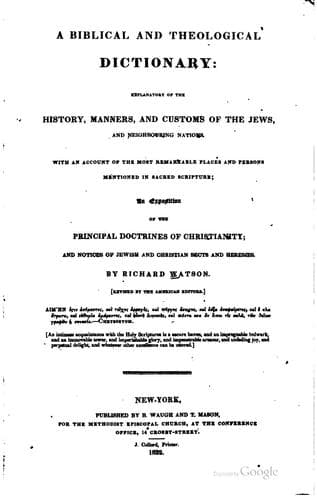
A Biblical and Theological Dictionary: explanatory of the history, manners, and customs of the Jews, and neighbouring nationsWatson, Richard
Religion
A Biblical and Theological Dictionary: explanatory of the history, manners, and customs of the Jews, and neighbouring nations
Watson, Richard
Bible -- Dictionaries; Theology -- Dictionaries
The first declaration, on this subject, after the appearance of Christ,
is that of John the Baptist, when he saw Jesus coming unto him, “Behold
the Lamb of God, which taketh away the sin of the world;” where it is
obvious, that when John called our Lord, “the Lamb of God,” he spoke of
him under a sacrificial character, and of the effect of that sacrifice
as an atonement for the sins of mankind. This was said of our Lord, even
before he entered on his public office; but if any doubt should exist
respecting the meaning of the Baptist’s expression, it is removed by
other passages, in which a similar allusion is adopted, and in which it
is specifically applied to the death of Christ, as an atonement for sin.
In the Acts of the Apostles, the following words of Isaiah are, by
Philip the evangelist, distinctly applied to Christ, and to his death:
“He was led as a sheep to the slaughter; and like a lamb dumb before his
shearer, so opened he not his mouth. in his humiliation his judgment was
taken away: and who shall declare his generation? for his life is taken
from the earth.” This particular part of the prophecy being applied to
our Lord’s death, the whole must relate to the same subject; for it is
undoubtedly one entire prophecy, and the other expressions in it are
still stronger: “He was wounded for our transgressions; he was bruised
for our iniquities; the chastisement of our peace was upon him; and with
his stripes we are healed: the Lord hath laid on him the iniquity of us
all.” In the First Epistle of Peter, is also a strong and very apposite
text, in which the application of the term “lamb” to our Lord, and the
sense in which it is applied, can admit of no doubt: “Forasmuch as ye
know that ye were not redeemed with corruptible things, but with the
precious blood of Christ, as of a lamb without blemish and without
spot,” 1 Peter i, 18, 19. It is therefore evident that the Prophet
Isaiah, six hundred years before the birth of Jesus; that John the
Baptist, on the commencement of his ministry; and that St. Peter, his
friend, companion and Apostle, subsequent to the transaction; speak of
Christ’s death as an atonement for sin, under the figure of a lamb
sacrificed.
Public-domain text, read in full here on John Shaqi.
Reviews
Reviews
No reviews yet
Be the first to share your thoughts on this work.
Elsewhere in the archive
Join the Discussion
Join the discussion
Sign in to leave a comment or review.
Sign InorCreate an account