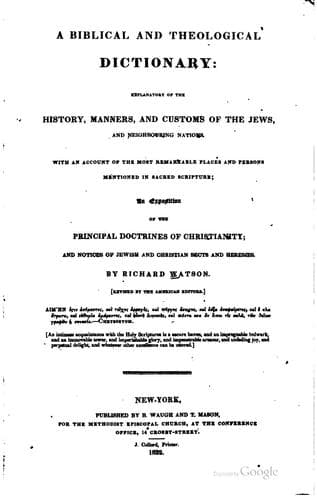
A Biblical and Theological Dictionary: explanatory of the history, manners, and customs of the Jews, and neighbouring nationsWatson, Richard
Religion
A Biblical and Theological Dictionary: explanatory of the history, manners, and customs of the Jews, and neighbouring nations
Watson, Richard
Bible -- Dictionaries; Theology -- Dictionaries
AUGUSTINE, or, as he is sometimes called in the court style of the
middle ages, ST. AUSTIN, one of the ancient fathers of the church, whose
writings for many centuries had almost as potent an influence on the
religious opinions of Christendom as those of Aristotle exercised over
philosophy. Indeed, it has often been mentioned as a fact, with
expressions of regret, that the writings of no man, those of the
Stagirite excepted, contributed more than those of St. Augustine to
encourage that spirit of subtle disquisition which subsequently
distinguished the era of the Schoolmen. He was born, November 13th, A.
D. 354, at Tagasta, an episcopal city of Numidia in Africa. His parents,
Patricius and Monica, were Christians of respectable rank in life, who
afforded their son all the means of instruction which his excellent
genius and wonderful aptitude for learning seemed to require. He studied
grammar and rhetoric at Madura, until he was sixteen years old; and
afterward removed to Carthage, to complete his studies. In both these
cities, in all the fervour of unregenerate youth, he entered eagerly
into the seducing scenes of dissipation and folly with which he was
surrounded, and became not only depraved but infamous in his conduct. In
this respect he was not improved by his subsequent connection with the
Manichees, whose unhallowed principles afforded an excuse for his
immorality, and threw a veil over the vilest of his actions. The
simplicity and minuteness with which he has narrated the numerous
incidents of his childhood, youth, and mature age, in his celebrated
book of “Confessions,” have afforded abundant matter of ridicule to the
profane and infidel wits of this and the last age. The reflections,
however, which accompany his narrative, are generally important and
judicious, and furnish to the moral philosopher copious materials for a
history of the varieties of the human heart, and are of superior value
to the humble Christian for the investigation and better knowledge of
his own. With a strange though not uncommon inconsistency, few books
have been more frequently quoted as authority on matters relating to
general literature and philosophy by infidels themselves, than St.
Augustine’s otherwise despised “Confessions,” and his “City of God.”
But, whatever else is taught in this remarkable piece of autobiography,
every pious reader will be delighted with the additional proofs which it
contains of the ultimate prevalence of faithful prayer, especially on
the part of Christian parents. Monica’s importunate prayers to heaven
followed the aberrations of her graceless son,--when he settled at
Carthage as a teacher of rhetoric; when he removed to Rome, and lodged
with a Manichee;--and when he finally settled at Milan as professor of
rhetoric. St. Ambrose was at that time, A. D. 384, bishop of Milan, and
to his public discourses Augustine began to pay much attention. His
heart became gradually prepared for the reception of divine truth, and
Public-domain text, read in full here on John Shaqi.
Reviews
Reviews
No reviews yet
Be the first to share your thoughts on this work.
Elsewhere in the archive
Join the Discussion
Join the discussion
Sign in to leave a comment or review.
Sign InorCreate an account