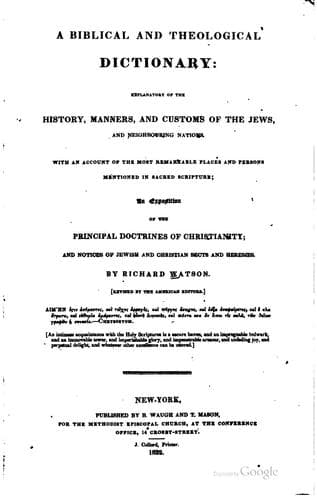
A Biblical and Theological Dictionary: explanatory of the history, manners, and customs of the Jews, and neighbouring nationsWatson, Richard
Religion
A Biblical and Theological Dictionary: explanatory of the history, manners, and customs of the Jews, and neighbouring nations
Watson, Richard
Bible -- Dictionaries; Theology -- Dictionaries
for that important change of heart and principles which constitutes
“conversion.” The circumstances attending this change, though often
related, are not unworthy of being repeated, if only to show that the
mode of the Holy Spirit’s operations was in substance the same in those
early days as they are now; and time was when some of the soundest
divines and most worthy dignitaries of the church of England were in the
habit of referring with approbation to this well attested instance of
change of heart. One of his Christian countrymen, Pontinius, who held a
high situation at court, having perceived a copy of St. Paul’s Epistles
lying on the table, entered one day into conversation with him and his
friend Alipius about the nature of faith and the happiness of those who
lived in the enjoyment of religion. Augustine was deeply affected at the
close of this visit; and when Pontinius had retired, giving vent to his
feelings he addressed Alipius in a most animated strain: “How is this?
What shall we do? Ignorant people come, and seize upon heaven; and we,
with our learning, (senseless wretches that we are!) behold we are
immersed in flesh and blood! Are we ashamed to follow them? Yet is it
not a still greater shame, not even to be able to follow them?” Full of
remorse and contrition Augustine left the house and retired to a secret
part of the garden, followed by his friend, who seemed on this occasion
to be a partaker of his grief only because he saw him grieved in spirit.
Unwilling to unman himself, as he accounted it, before Alipius, he left
him; and throwing himself down under the branches of a large fig tree he
poured out a torrent of tears which he was unable any longer to
restrain, and exclaimed in bitterness of soul, “When, O Lord, when will
thy anger cease? Why tomorrow? Why not at this time?” He instantly heard
what he considered to be the voice of a child, saying _Tolle, lege_,
“Take and read.” These two Latin words were repeated several times;
Augustine reflected upon them, checked his tears, received them as the
voice of God, and running into the house, opened, according to the
divine direction, the Epistles of St. Paul which he had left on the
table, and attentively read the first passage which he found. It was
Romans xiii, 13, 14; a passage peculiarly applicable to him, in
reference to his former habits and present state of mind: “Not in
rioting and drunkenness, not in chambering and wantonness, not in strife
and envying: but put ye on THE LORD JESUS CHRIST, and make not provision
for the flesh to fulfil the lusts thereof.” He shut up the book, and was
amazed that all his doubts and fears had vanished. Alipius was speedily
informed of this wonderful change in his feelings and views; and after
having desired to see the two verses, in the spirit of a true seeker he
pointed out to Augustine the passage which immediately follows, and
which he considered as peculiarly adapted to his own case: “Him that is
weak in the faith receive ye,” &c, Rom.
Public-domain text, read in full here on John Shaqi.
Reviews
Reviews
No reviews yet
Be the first to share your thoughts on this work.
Elsewhere in the archive
Join the Discussion
Join the discussion
Sign in to leave a comment or review.
Sign InorCreate an account