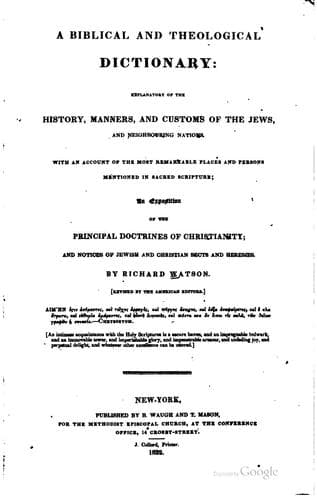
A Biblical and Theological Dictionary: explanatory of the history, manners, and customs of the Jews, and neighbouring nationsWatson, Richard
Religion
A Biblical and Theological Dictionary: explanatory of the history, manners, and customs of the Jews, and neighbouring nations
Watson, Richard
Bible -- Dictionaries; Theology -- Dictionaries
prayers which the church offers up either for the conversion of
unbelievers and other sinners, or for the perseverance of believers, are
poured forth in vain. The unrestricted capability of men’s own free will
is amply sufficient for all these things, and therefore no necessity
exists for asking of God those things which we are able of ourselves to
obtain; the gifts of grace being only necessary to enable men to do that
more easily and completely which yet they could do themselves though
more slowly and with greater difficulty; and that they are perfectly
free creatures,” in opposition to all the current notions of
predestination and reprobation. These novel opinions were refuted by St.
Augustine and St. Jerom, as well as by Orosius a Spanish presbyter, and
they were condemned as heresies in the council of Carthage and in that
of Milevum. The discussions which then arose have been warmly agitated
in various subsequent periods of the Christian church, though little new
light has been thrown upon them from that age to the present. In his
eagerness to confute these opponents St. Augustine employed language so
strong as made it susceptible of an interpretation wholly at variance
with the accountability of man. This led to farther explanations and
modifications of his sentiments, which were multiplied when the
Semi-Pelagians arose, who thought that the truth lay between his
doctrines and those of the Pelagians. Concerning original sin, he
maintained that it was derived from our first parents; and he believed
he had ascertained in what the original sin conveyed by Adam to his
posterity consisted. In his sentiments, however, upon the latter point
he was rather inconsistent, at one time asserting that the essence of
original sin was concupiscence, and at another expressing doubts
respecting his own position. This subject was bequeathed as a legacy to
the schoolmen of a subsequent age, who exercised their subtle wits upon
all its ramifications down to the period of the council of Trent. On the
consequences of the fall of our first parents, St. Augustine taught that
by it human nature was totally corrupted, and deprived of all
inclination and ability to do good. Before the age in which he lived,
the early fathers held what, in the language of systematic theology, is
termed the synergestic system, or the needfulness of human coöperation
in the works of holiness; but though the freedom of the will was not
considered by them as excluding or rendering unnecessary the grace of
God, yet much vagueness is perceptible in the manner in which they
express themselves, because they had not examined the subject with the
same attention as the theologians by whom they were succeeded. Those
early divines generally used the language of Scripture, the fertile
invention of controversial writers, not having as yet displayed itself,
except on the divine nature of Jesus Christ, and subsidiary terms and
learned distinctions not being then required by any great differences of
Public-domain text, read in full here on John Shaqi.
Reviews
Reviews
No reviews yet
Be the first to share your thoughts on this work.
Elsewhere in the archive
Join the Discussion
Join the discussion
Sign in to leave a comment or review.
Sign InorCreate an account