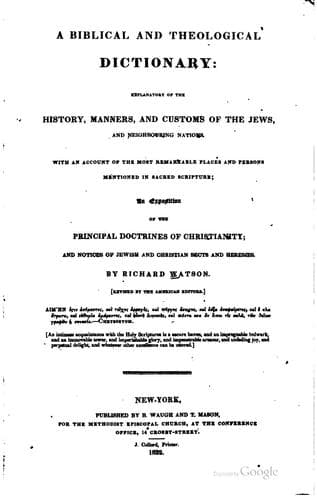
A Biblical and Theological Dictionary: explanatory of the history, manners, and customs of the Jews, and neighbouring nationsWatson, Richard
Religion
A Biblical and Theological Dictionary: explanatory of the history, manners, and customs of the Jews, and neighbouring nations
Watson, Richard
Bible -- Dictionaries; Theology -- Dictionaries
xiv, 1. The two friends then ran
to acquaint Monica with these circumstances, the knowledge of which
transported her with joy.
In a frame of mind not unfamiliar to those who have themselves had “much
forgiven,” Augustine wished to retire at once from so wicked a world as
that in which he had passed the first thirty-two years of his dissolute
life. His secession, however, was only a temporary one; for he and
Alipius were, a few months afterward, received by baptism into the
Christian church. After having composed several religious treatises in
his retreat near Tagasta, especially against the errors of the
Manichees, from which he had been so recently reclaimed, he was, in the
year 392, ordained priest by Valerius, bishop of Hippo, now a part of
the Barbary States on the coast of Africa. He there held a public
disputation with Fortunatus, a celebrated priest among the Manichees,
and acquitted himself with great spirit and success, he also wrote and
preached largely and to great effect against the Donatists and
Manichees. His reputation as a divine increased; and he was, at the
close of the year 395, ordained bishop of Hippo, in which high station
he continued with great advantage to wage war against various orders of
heretics.
Augustine had hitherto directed his theological artillery principally
against the predestinarian errors of the Manichees; but he was soon
called upon to change his weapons and his mode of warfare, in attacking
a new and not less dangerous class of heretics. In the year 412 he began
to write against the injurious doctrines of Pelagias, a native of
Britain, who had resided for a considerable time at Rome, and acquired
universal esteem by the purity of his manners, his piety, and his
erudition. Alarmed at the consequences which seemed to him obviously to
result from allowing that Adam’s sin is transmitted to all his
posterity, and fortified in his sentiments on this subject by those of
Origen and Ruffinus, with the latter of whom he had associated, he
boldly denied tenets which he did not believe. In the defence of his
opinions, Pelagius, was seconded by Celestius, a man equally eminent for
his talents and his virtues. Their principles were propagated at first
rather by hints and intimations, than by open avowal and plain
declarations; but this reserve was laid aside when they perceived the
ready reception which their doctrines obtained; and Celestius began
zealously to disseminate them in Africa, while Pelagius sowed the same
tares in Palestine, whence they were speedily transplanted to almost
every corner of Christendom. If the brief notices, which have come down
to us respecting their tenets, in the writings of their adversaries, be
correct, they affirmed, “It is not _free_ will if it requires the aid of
God; because every one has it within the power of his own will to do any
thing, or not to do it. Our victory over sin and Satan proceeds not from
the help which God affords, but is owing to our own free will. The
Public-domain text, read in full here on John Shaqi.
Reviews
Reviews
No reviews yet
Be the first to share your thoughts on this work.
Elsewhere in the archive
Join the Discussion
Join the discussion
Sign in to leave a comment or review.
Sign InorCreate an account