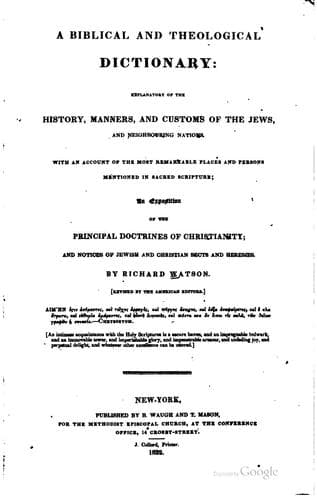
A Biblical and Theological Dictionary: explanatory of the history, manners, and customs of the Jews, and neighbouring nationsWatson, Richard
Religion
A Biblical and Theological Dictionary: explanatory of the history, manners, and customs of the Jews, and neighbouring nations
Watson, Richard
Bible -- Dictionaries; Theology -- Dictionaries
After St. Augustine had thus in a great degree new moulded the science
of theology, and had combined with it as an essential part of divine
truth, that the fate of mankind was determined by the divine decree
independently of their own efforts and conduct, and that they were thus
divided into the elect and reprobate, it became necessary, in order to
preserve consistency, to introduce into his system a limitation with
respect to baptism, and to prevent the opinions concerning it from
interfering with those which flowed from the doctrine of predestination.
He accordingly taught, that baptism brings with it the forgiveness of
sins; that it is so essential, that the omission of it will expose us to
condemnation; and that it is attended with regeneration. He also
affirmed that the virtue of baptism is not in the water; that the
ministers of Christ perform the external ceremony, but that Christ
accompanies it with invisible grace; that baptism is common to all,
whilst, grace is not so; and that the same external rite may be death to
some, and life to others. By this distinction he rids himself of the
difficulty which would have pressed upon his scheme of theology, had
pardon, regeneration, and salvation been _necessarily_ connected with
the outward ordinance of baptism; and limits its proper efficacy to
those who are comprehended, as the heirs of eternal life, in the decree
of the Almighty. Many, however, of those who strictly adhere to him in
other parts of his doctrinal system, desert him at this point. Bishop
Bedell speaks thus in disparagement of his baptismal views, in a letter
to Dr. Ward: “This I do yield to my Lord of Sarum most willingly, that
the justification, sanctification, and adoption which children have in
baptism, is not _univocè_ [univocally] the same with that which _adulti_
[adults] have. I think the emphatical speeches of Augustine against the
Pelagians, and of Prosper, are not so much to be regarded (who say the
like of the eucharist also) touching the necessity and efficacy in the
case of infants; and they are very like the speeches of Lanfranc and
Guitmund of Christ’s presence in the sacrament, opposing _veracitér_,
[truly] and _veré_ [truly] to _sacramentalitér_; [sacramentally;] which
is a false and absurd contraposition. The opinion of the Franciscans out
of Scotus and Bernard, mentioned in the council of Trent, seems to be
the true opinion; for they make the sacraments to be effectual, ‘because
God gives them _effectus regularitér concomitantes_,’ [regularly
accompanying effects,] and to contain grace no otherwise than as an
effectual sign; and that grace is received by them as an investiture by
a ring or staff, which is _obsignando_, [by signation.] Consider that if
you will aver, that baptism washes away otherwise than sacramentally,
that is, obsignatorily, original sin; yet you must allow that manner of
washing for future actual sins; and you must make two sorts of
Public-domain text, read in full here on John Shaqi.
Reviews
Reviews
No reviews yet
Be the first to share your thoughts on this work.
Elsewhere in the archive
Join the Discussion
Join the discussion
Sign in to leave a comment or review.
Sign InorCreate an account