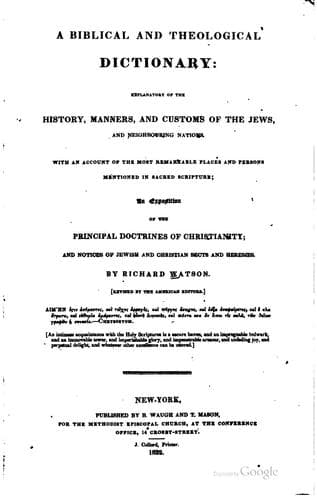
A Biblical and Theological Dictionary: explanatory of the history, manners, and customs of the Jews, and neighbouring nationsWatson, Richard
Religion
A Biblical and Theological Dictionary: explanatory of the history, manners, and customs of the Jews, and neighbouring nations
Watson, Richard
Bible -- Dictionaries; Theology -- Dictionaries
justification, one for children, another for _adulti_; [adults;] and
(which passes all the rest) you must find some promise in God’s covenant
wherein he binds himself to wash away sin without faith or repentance.
By this doctrine, you must also maintain that children do spiritually
eat the flesh of Christ and drink his blood, if they receive the
eucharist, as for ages they did, and by the analogy of the passover they
may; and sith [if] the use of this sacrament _toties quoties_ [as often
as it is used] must needs confer grace, it seems it were necessary to
let them communicate, and the oftener the better, to the intent they
might be stronger in grace: which opinion, though St. Austin and many
more of the ancients do maintain, I believe you will not easily
condescend unto, or that children dying without baptism are damned.”
These remarks are important, as proceeding from the pen of the personal
friend of Father Paul, who wrote the History of the council of Trent.
In the various discussions which have arisen concerning predestination
and the doctrines with which it is connected, some modern divines have
quoted the arguments of St. Augustine against the Manichees, and others
those which he employed against the Pelagians, according to the
discordant views which the combatants severally entertain on these
controverted points. One of them has thus expressed himself, in his
endeavour to reconcile St Augustine with himself:--“The heresy of
Pelagius being suppressed, the catholic doctrine in that point became
more settled and confirmed by the opposition; such freedom being left to
the will of man, as was subservient unto grace, coöperating in some
measure with those heavenly influences. And so much is confessed by St.
Augustine himself, where he asks this question, ‘Doth any man affirm
that free will is perished utterly from man by the fall of Adam?’ And
thereunto he makes this answer: ‘Freedom is perished by sin; but it is
that freedom only which we had in paradise, of having perfect
righteousness with immortality.’ For, otherwise, it appears to be his
opinion, that man was not merely passive in all the acts of grace which
conduced to glory, according to the memorable saying of his, so common
in the mouths of all men, ‘He who first made us without our help will
not vouchsafe to save us at last without our concurrence.’ If any
harsher expressions have escaped his pen, (as commonly it happeneth in
the heats of a disputation,) they are to be qualified by this last rule,
and by that before, in which it was affirmed, that ‘God could not with
justice judge and condemn the world, if all men’s sins proceeded not
from their own free will, but from some overruling providence which
inforced them to it.‘” Another admirer of this father offers the
following as an attempt at reconciliation: “St. Augustine denied that
the coöperation of man is at all exerted to produce the renewal of our
nature; but, when the renewal had been produced, he admitted that there
Public-domain text, read in full here on John Shaqi.
Reviews
Reviews
No reviews yet
Be the first to share your thoughts on this work.
Elsewhere in the archive
Join the Discussion
Join the discussion
Sign in to leave a comment or review.
Sign InorCreate an account