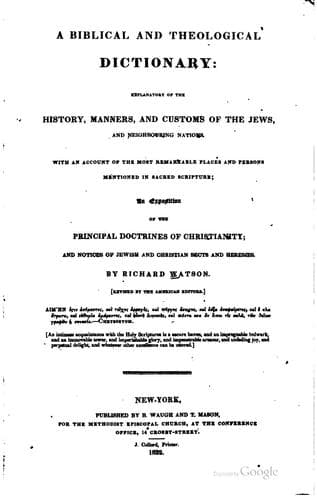
A Biblical and Theological Dictionary: explanatory of the history, manners, and customs of the Jews, and neighbouring nationsWatson, Richard
Religion
A Biblical and Theological Dictionary: explanatory of the history, manners, and customs of the Jews, and neighbouring nations
Watson, Richard
Bible -- Dictionaries; Theology -- Dictionaries
sneers of a thousand infidels. See PELAGIANS and SYNODS.
AUGUSTUS, emperor of Rome, and successor of Julius Cæsar. The battle of
Actium, which he fought with Mark Antony, and which made him master of
the empire, happened fifteen years before the birth of Christ. This is
the emperor who appointed the enrolment mentioned Luke ii, 1, which
obliged Joseph and the Virgin Mary to go to Bethlehem, the place where
Jesus Christ was born. Augustus procured the crown of Judea for Herod,
from the Roman senate. After the defeat of Mark Antony, Herod adhered to
Augustus, and was always faithful to him; so that Augustus loaded him
with honours and riches.
AVEN, a city of Egypt, afterward called Heliopolis, and On, Ezek. xxx,
17. Herodotus informs us that in this city there was an annual assembly
in honour of the sun, and a temple dedicated to him. It appears,
however, highly probable, by the behaviour of Pharaoh to Joseph and
Jacob, and especially by Joseph’s care to preserve the land to the
priests, Gen. xlvii, 22, 26, that the true religion prevailed in Egypt
in his time; and it is incredible that Joseph should have married the
daughter of the priest of On, had that name among the Egyptians denoted
only the material light; which, however, no doubt they, like all the
rest of the world, idolized in after times, and to which we find a
temple dedicated among the Canaanites, under this name, Joshua vii, 2.
AVENGER OF BLOOD. He who prosecuted the man-slayer under the law was
called the avenger of blood, and had a right to slay the person, if he
found him without a city of refuge. See GOEL.
AVIMS, a people descended from Hevus, the son of Canaan. They dwelt at
first in the country which was afterward possessed by the Caphtorims, or
Philistines. The Scripture says expressly, that the Caphtorims drove out
the Avims, who dwelt in Hazerim, even unto Azzah, Deut. ii, 23. There
were also Avims, or Hivites, at Shechem, or Gibeon, Joshua xi, 19; for
the inhabitants of Shechem were Hivites. Lastly, there were some of them
beyond Jordan, at the foot of Mount Hermon. Bochart thinks, that Cadmus,
who conducted a colony of the Phœnicians into Greece, was a Hivite.
His name, Cadmus, comes from the Hebrew _Kedem_, “the east,” because he
came from the eastern parts of the land of Canaan. The name of his wife
Hermione was taken from Mount Hermon, at the foot whereof the Hivites
dwelt. The metamorphoses of the companions of Cadmus into serpents is
founded upon the signification of the name of Hivites, which, in the
Phœnician language, signifies _serpents_.
Public-domain text, read in full here on John Shaqi.
Reviews
Reviews
No reviews yet
Be the first to share your thoughts on this work.
Elsewhere in the archive
Join the Discussion
Join the discussion
Sign in to leave a comment or review.
Sign InorCreate an account