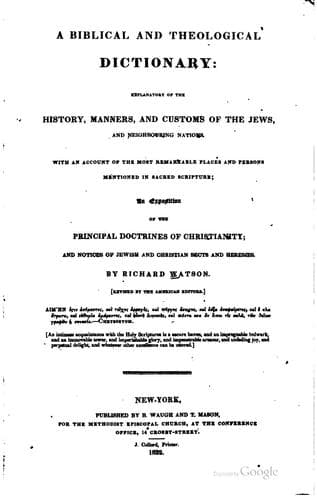
A Biblical and Theological Dictionary: explanatory of the history, manners, and customs of the Jews, and neighbouring nationsWatson, Richard
Religion
A Biblical and Theological Dictionary: explanatory of the history, manners, and customs of the Jews, and neighbouring nations
Watson, Richard
Bible -- Dictionaries; Theology -- Dictionaries
The character of this eminent father has been much misrepresented both
as a man and as a writer. Whoever looks into his writings for accurate
and enlarged views of Christian doctrine, looks for that which could not
be expected in the very infancy of Biblical criticism. He was a
rhetorician by profession, and the degenerate taste of that age must be
blamed, rather than the individual who wrote in the style which then
prevailed. The learning of St. Augustine, and particularly his knowledge
of Greek, have been disputed; and hence the importance of his Biblical
criticisms has been depreciated. In the account of the early part of his
life he confesses his great aversion to the study of that language; and
as he tells us, in his maturer age, that he read the Platonists in a
Latin version, it has perhaps been too hastily concluded that he never
made any great proficiency in it. But though it be allowed that his
comments on Scripture consist chiefly of popular reflections, spiritual
and moral, or allegorical and mystical perversions of the literal
meaning; yet the works of this father are not wholly destitute of
remarks and critical interpretations, that are pertinent and judicious:
to such, after a series of extracts from his writings, Dr. Lardner has
referred his readers. With regard to his knowledge of Greek, this
impartial and candid author is of opinion, that he understood that
language better than some have supposed; and he has cited several
passages from which it may be perceived, that St. Augustine frequently
compared his copies of the Latin version with those of the Greek
original. Le Clerc himself allows that he sometimes explains Greek words
and phrases in a very felicitous manner. Indeed, the commencement of his
correspondence with St. Jerom proves him to have been no contemptible
critic. In this he besought him, in the name of all the African
churches, to apply himself to the translation into Latin of the Greek
interpreters of Scripture, rather than to enter upon a new translation
from the original Hebrew; and to point out those passages in which the
Hebrew differed from the Septuagint, as he had previously done in the
book of Job. Voltaire and other profane wits have, in the exercise of
their buffoonery, impeached his moral conduct; but their charges, when
impartially examined, will be seen to be founded in ignorance or in
malice. They resemble those which the same parties prefer against
Prophets, Apostles, and against Christ himself. Mosheim observes that
Augustine’s high reputation filled the Christian world; and “not without
reason, as a variety of great and shining qualities were united in the
character of that illustrious man. A sublime genius, an uninterrupted
and zealous pursuit of truth, an indefatigable application, an
invincible patience, a sincere piety, and a subtle and lively wit,
conspired to establish his fame upon the most lasting foundations.” Such
a testimony as this far outweighs the vituperative remarks and petty
Public-domain text, read in full here on John Shaqi.
Reviews
Reviews
No reviews yet
Be the first to share your thoughts on this work.
Elsewhere in the archive
Join the Discussion
Join the discussion
Sign in to leave a comment or review.
Sign InorCreate an account