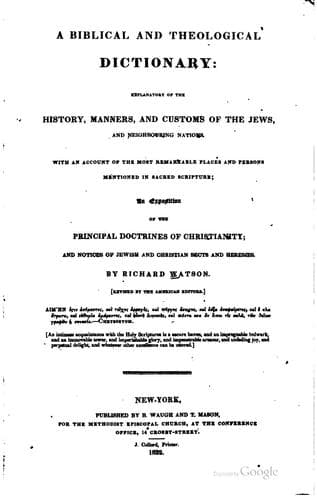
A Biblical and Theological Dictionary: explanatory of the history, manners, and customs of the Jews, and neighbouring nationsWatson, Richard
Religion
A Biblical and Theological Dictionary: explanatory of the history, manners, and customs of the Jews, and neighbouring nations
Watson, Richard
Bible -- Dictionaries; Theology -- Dictionaries
BAAL, BEL, or BELUS, denoting _lord_, a divinity among several ancient
nations; as the Canaanites, Phœnicians, Sidonians, Carthaginians,
Babylonians, Chaldeans, and Assyrians. The term _Baal_, which is itself
an appellative, served at first to denote the true God, among those who
adhered to the true religion. Accordingly, the Phœnicians, being
originally Canaanites, having once had, as well as the rest of their
kindred, the knowledge of the true God, probably called him _Baal_, or
_lord_. But they, as well as other nations, gradually degenerating into
idolatry, applied this appellation to their respective idols; and thus
were introduced a variety of divinities, called _Baalim_, or _Baal_,
with some epithet annexed to it, as _Baal Berith_, _Baal Gad_, _Baal
Moloch_, _Baal Peor_, _Baal Zebub_, &c. Some have supposed that the
descendants of Ham first worshipped the sun under the title of Baal, 2
Kings xxiii, 5, 11; and that they afterward ascribed it to the patriarch
who was the head of their line; making the sun only an emblem of his
influence or power. It is certain, however, that when the custom
prevailed of deifying and worshipping those who were in any respect
distinguished among mankind, the appellation of Baal was not restricted
to the sun, but extended to those eminent persons who were deified, and
who became objects of worship in different nations. The Phœnicians
had several divinities of this kind, who were not intended to represent
the sun. It is probable that Baal, Belus, or Bel, the great god of the
Carthaginians, and also of the Sidonians, Babylonians, and Assyrians,
who, from the testimony of Scripture, appears to have been delighted
with human sacrifices, was the Moloch of the Ammonites; the Chronus of
the Greeks, who was the chief object of adoration in Italy, Crete,
Cyprus, and Rhodes, and all other countries where divine honours were
paid him; and the Saturn of the Latins. In process of time, many other
deities, beside the principal ones just mentioned, were distinguished by
the title of Baal among the Phœnicians, particularly those of Tyre,
and of course among the Carthaginians, and other nations. Such were
Jupiter, Mars, Bacchus, and Apollo, or the sun.
The temples and altars of Baal were generally placed on eminences: they
were places inclosed by walls, within which was maintained a perpetual
fire; and some of them bad statues or images, called in Scripture
“Chamanim.” Maundrell, in his journey from Aleppo to Jerusalem,
observed, some remains of these enclosures in Syria. Baal had his
prophets and his priests in great numbers; accordingly, we read of four
hundred and fifty of them that were fed at the table of Jezebel only;
and they conducted the worship of this deity, by offering sacrifices, by
dancing round his altar with violent gesticulations and exclamations, by
cutting their bodies with knives and lancets, and by raving and
pretending to prophesy, as if they were possessed by some invisible
power.
Public-domain text, read in full here on John Shaqi.
Reviews
Reviews
No reviews yet
Be the first to share your thoughts on this work.
Elsewhere in the archive
Join the Discussion
Join the discussion
Sign in to leave a comment or review.
Sign InorCreate an account