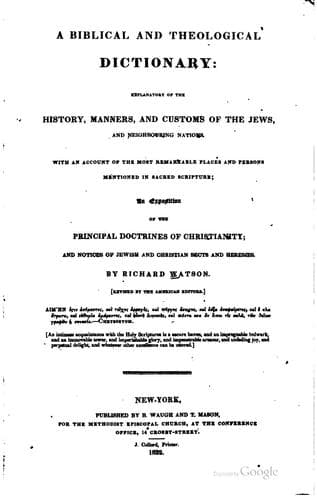
A Biblical and Theological Dictionary: explanatory of the history, manners, and customs of the Jews, and neighbouring nationsWatson, Richard
Religion
A Biblical and Theological Dictionary: explanatory of the history, manners, and customs of the Jews, and neighbouring nations
Watson, Richard
Bible -- Dictionaries; Theology -- Dictionaries
It is remarkable that we do not find the name Baal so much in popular
use east of Babylonia; but it was general west of Babylonia, and to the
very extremity of western Europe, including the British isles. The
worship of Bel, Belus, Belenus, or Belinus, was general throughout the
British islands; and certain of its rites and observances are still
maintained among us, notwithstanding the establishment of Christianity
during so many ages. A town in Perthshire, on the borders of the
Highlands, is called _Tilliebeltane_ or _Tulliebeltane_; that is, the
_eminence_, or _rising ground, of the fire of Baal_. In the
neighbourhood is a Druidical temple of eight upright stones, where it is
supposed the fire was kindled. At some distance from this is another
temple of the same kind, but smaller; and near it a well still held in
great veneration. On Beltane morning, superstitious people go to this
well, and drink of it; then they make a procession round it nine times.
After this they in like manner go round the temple. So deep-rooted is
this Heathenish superstition in the minds of many who reckon themselves
good Protestants, that they will not neglect these rites, even when
Beltane falls on the Sabbath.
In Ireland, Bel-tein is celebrated on the twenty-first of June, at the
time of the solstice. There, as they make fires on the tops of hills,
every member of the family is made to pass through the fire; as they
reckon this ceremony necessary to ensure good fortune through the
succeeding year. This resembles the rites used by the Romans in the
Palilia. Bel-tein is also observed in Lancashire.
In Wales, this annual fire is kindled in autumn, on the first day of
November; which being neither at the solstice nor equinox, deserves
attention. It may be accounted for by supposing that the lapse of ages
has removed it from its ancient station, and that the observance is kept
on the same day, nominally, though that be now removed some weeks
backward from its true station. However that may be, in North Wales
especially, this fire is attended by many ceremonies; such as running
through the fire and smoke, each participator casting a stone into the
fire.
The Hebrews often imitated the idolatry of the Canaanites in adoring
Baal. They offered human sacrifices to him in groves, upon high places,
and upon the terraces of houses. Baal had priests and prophets
consecrated to his service. All sorts of infamous and immodest actions
were committed in the festivals of Baal and Astarte. See Jer. xxxii, 35;
2 Kings xvii, 16; xxiii, 4, 5, 12; 1 Kings xviii, 22; 2 Kings x, 19; 1
Kings xiv, 24; xv, 12; 2 Kings xxiii, 7; Hosea iv, 14. This false deity
is frequently mentioned in Scripture in the plural number, _Baalim_,
which may intimate that the name _Baal_ was given to several different
deities.
Public-domain text, read in full here on John Shaqi.
Reviews
Reviews
No reviews yet
Be the first to share your thoughts on this work.
Elsewhere in the archive
Join the Discussion
Join the discussion
Sign in to leave a comment or review.
Sign InorCreate an account