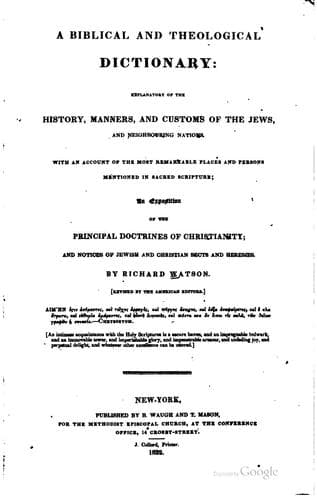
A Biblical and Theological Dictionary: explanatory of the history, manners, and customs of the Jews, and neighbouring nationsWatson, Richard
Religion
A Biblical and Theological Dictionary: explanatory of the history, manners, and customs of the Jews, and neighbouring nations
Watson, Richard
Bible -- Dictionaries; Theology -- Dictionaries
“At day light I departed for the ruins, with a mind absorbed by the
objects which I had seen yesterday. An hour’s walk, indulged in intense
reflection, brought me to the grandest and most gigantic northern mass,
on the eastern bank of the Euphrates, and distant about four miles and a
half from the eastern suburb of Hillah. It is called by the natives, _El
Mujellibah_, ‘the overturned;’ also _Haroot_ and _Maroot_, from a
tradition handed down, with little deviation, from time immemorial, that
near the foot of the ruin there is a well, invisible to mortals, in
which those rebellious angels were condemned by God to be hung with
their heels upward, until the day of judgment, as a punishment for their
wickedness. This solid mound, which I consider, from its situation and
magnitude, to be the remains of the Tower of Babel, (an opinion likewise
adopted by that venerable and highly distinguished geographer, Major
Rennell,) is a vast oblong square, composed of kiln-burnt and sun-dried
bricks, rising irregularly to the height of one hundred and thirty-nine
feet, at the south-west; whence it slopes toward the north-east to a
depth of one hundred and ten feet. Its sides face the four cardinal
points. I measured them carefully, and the following is the full extent
of each face: that to the north, along the visible face, is two hundred
and seventy-four yards; to the south, two hundred and fifty-six yards;
to the east, two hundred and twenty-six yards; and to the west, two
hundred and forty yards. The summit is an uneven flat, strewed with
broken and unbroken bricks, the perfect ones measuring thirteen inches
square, by three thick. Many exhibited the arrow-headed character, which
appeared remarkably fresh. Pottery, bitumen, vitrified and petrified
brick, shells, and glass, were all equally abundant. The principal
materials composing this ruin are, doubtless, mud bricks baked in the
sun, and mixed up with straw. It is not difficult to trace brick work
along each front, particularly at the south-west angle, which is faced
by a wall, composed partly of kiln-burnt brick, that in shape exactly
resembles a watch tower or small turret. On its summit there are still
considerable traces of erect building; at the western end is a circular
mass of sold brick work, sloping toward the top, and rising from a
confused heap of rubbish. The chief material forming this fabric
appeared similar to that composing the ruin called Akercouff, a mixture
of chopped straw, with slime used as cement; and regular layers of
unbroken reeds between the horizontal courses of the bricks. The base is
greatly injured by time and the elements; particularly to the
south-east, where it is cloven into a deep furrow from top to bottom.
The sides of the ruin exhibit hollows worn partly by the weather, but
more generally formed by the Arabs, who are incessantly digging for
bricks, and hunting for antiquities.”
Public-domain text, read in full here on John Shaqi.
Reviews
Reviews
No reviews yet
Be the first to share your thoughts on this work.
Elsewhere in the archive
Join the Discussion
Join the discussion
Sign in to leave a comment or review.
Sign InorCreate an account