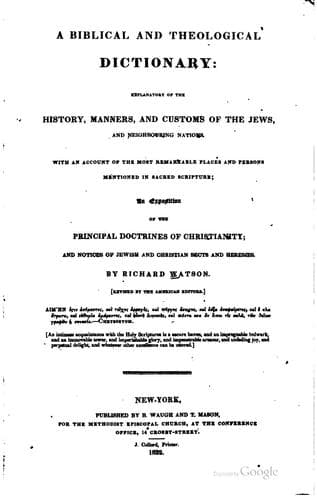
A Biblical and Theological Dictionary: explanatory of the history, manners, and customs of the Jews, and neighbouring nationsWatson, Richard
Religion
A Biblical and Theological Dictionary: explanatory of the history, manners, and customs of the Jews, and neighbouring nations
Watson, Richard
Bible -- Dictionaries; Theology -- Dictionaries
BABYLON, 2 Kings xxiv, 1. The capital of Chaldea, built by Nimrod, Gen.
x, 10. It was under Nebuchadnezzar that Babylon, then become the seat of
universal empire, is supposed to have acquired that extent and
magnificence, and that those stupendous works were completed which
rendered it the wonder of the world and of posterity: and accordingly,
this prince, then the most potent on the earth, arrogated to himself the
whole glory of its erection; and in the pride of his heart exclaimed,
“Is not this great Babylon that I have built?” The city at this period
stood on both sides of the river, which intersected it in the middle. It
was, according to the least computation, that of Diodorus Siculus, 45
miles in circumference; and according to Herodotus, the older author of
the two, 60 miles. Its shape was that of a square, traversed each way by
25 principal streets; which of course intersected each other, dividing
the city into 626 squares. These streets were terminated at each end by
gates of brass, of prodigious size and strength, with a smaller one
opening toward the river. The walls, from the most moderate accounts,
were 75 feet in height and 32 in breadth; while Herodotus makes them 300
in height and 75 in breadth: which last measurement, incredible as it
may seem, is worthy of credit, as Herodotus is much the oldest author
who describes them, and who gives their original height; whereas, those
who follow him in their accounts of these stupendous walls, describe
them as they were after they had been taken down to the less elevation
by Darius Hystaspes. They were built of brick, cemented with bitumen
instead of mortar; and were encompassed by a broad and deep ditch, lined
with the same materials, as were also the banks of the river in its
course through the city: the inhabitants descending to the water by
steps through the smaller brazen gates before mentioned. The houses were
three or four stories high, separated from each other by small courts or
gardens, with open spaces and even fields interspersed over the immense
area enclosed within the walls. Over the river was a bridge, connecting
the two halves of the city, which stood, the one on its eastern, and the
other on its western, bank; the river running nearly north and south.
The bridge was 5 furlongs in length, and 30 feet in breadth, and had a
palace at each end, with, it is said, a subterraneous passage beneath
the river, from one to the other: the work of Semiramis. Within the city
was the temple of Belus, or Jupiter, which Herodotus describes as a
square of two stadia, or a quarter of a mile: in the midst of which
arose the celebrated tower, to which both the same writer, and Strabo,
give an elevation of one stadium, or 660 feet; and the same measure at
its base; the whole being divided into eight separate towers, one above
another, of decreasing dimensions to the summit; where stood a chapel,
containing a couch, table, and other things of gold. Here the principal
Public-domain text, read in full here on John Shaqi.
Reviews
Reviews
No reviews yet
Be the first to share your thoughts on this work.
Elsewhere in the archive
Join the Discussion
Join the discussion
Sign in to leave a comment or review.
Sign InorCreate an account