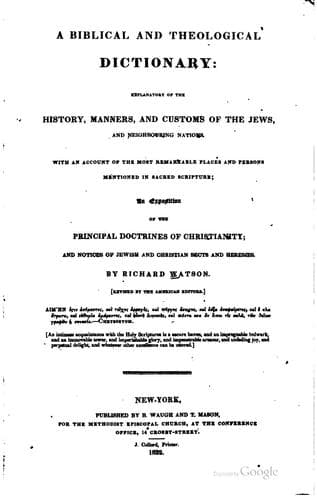
A Biblical and Theological Dictionary: explanatory of the history, manners, and customs of the Jews, and neighbouring nationsWatson, Richard
Religion
A Biblical and Theological Dictionary: explanatory of the history, manners, and customs of the Jews, and neighbouring nations
Watson, Richard
Bible -- Dictionaries; Theology -- Dictionaries
When in the plenitude of its greatness, splendour and strength, Babylon
first yielded to the arms of Cyrus, whose name, and the manœuvre by
which the city was taken, were mentioned by Isaiah nearly two hundred
years before the event; which was also predicted by Jeremiah: “Go up, O
Elam, (or Persia,) besiege, O Media. The Lord hath raised up the spirit
of the kings of the Medes, for his device is against Babylon, to destroy
it.” The kings of Persia and Media, prompted by a common interest,
freely entered into a league against Babylon, and with one accord
entrusted the command of their united armies to Cyrus, the relative and
eventually the successor of them both.--But the taking of Babylon was
not reserved for these kingdoms alone: other nations had to be “prepared
against her.” “Set up a standard in the land; blow the trumpet among the
nations, prepare the nations against her, call together against her the
kingdoms of Ararat, Minni, and Aschenaz: Lo, I will raise and cause to
come up against Babylon an assembly of great nations from the north
country,” &c. Cyrus subdued the Armenians, who had revolted against
Media, spared their king, bound them over anew to their allegiance, by
kindness rather than by force, and incorporated their army with his
own.--“The mighty men of Babylon have foreborne to fight. They have
remained in their holds; their might hath failed, they became as women.”
So dispirited became its people, that Babylon, which had made the world
to tremble, was long besieged, without making any effort to drive off
the enemy. But, possessed of provisions for twenty years, which in their
timid caution they had plentifully stored, they derided Cyrus from their
impregnable walls, within which they remained. Their profligacy, their
wickedness and false confidence were unabated; they continued to live
carelessly in pleasures: and Babylon the great, unlike to many a small
fortress and unwalled town, made not one struggle to regain its freedom
or to be rid of the foe.--Much time having been lost, and no progress
being made in the siege, the anxiety of Cyrus was strongly excited, and
he was reduced to great perplexity, when at last it was suggested and
immediately determined to divert the course of the Euphrates. And while
the unconscious and reckless citizens were engaged in dancing and
merriment, the river was suddenly turned into the lake, the trench, and
the canals; and the Persians, both foot and horse, so soon as the
subsiding of the water permitted, entered by its channel, and were
followed by the allies in array, along the dry part of the river. “I
will dry up thy sea, and make thy springs dry. That saith to the deep,
Be dry, I will dry up thy rivers.”--One detachment was placed where the
river first enters the city, and another where it leaves it. And “one
post did run to meet another, and one messenger to meet another, to show
the king of Babylon that his city is taken at the end, and that the
Public-domain text, read in full here on John Shaqi.
Reviews
Reviews
No reviews yet
Be the first to share your thoughts on this work.
Elsewhere in the archive
Join the Discussion
Join the discussion
Sign in to leave a comment or review.
Sign InorCreate an account