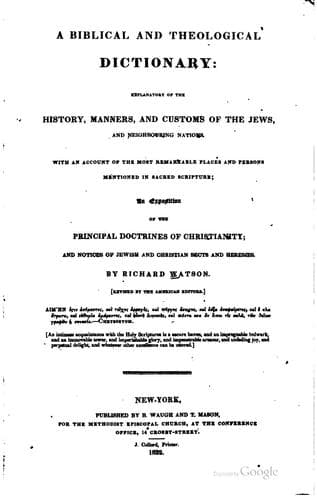
A Biblical and Theological Dictionary: explanatory of the history, manners, and customs of the Jews, and neighbouring nationsWatson, Richard
Religion
A Biblical and Theological Dictionary: explanatory of the history, manners, and customs of the Jews, and neighbouring nations
Watson, Richard
Bible -- Dictionaries; Theology -- Dictionaries
passages are shut.” “They were taken,” says Herodotus, “by _surprise_;
and such is the extent of the city, that, as the inhabitants themselves
affirm, they who lived in the extremities were made prisoners before any
alarm was communicated to the centre of the place,” where the palace
stood. Thus a “snare was laid for Babylon, it was taken, and it was not
aware; it was found and also caught; for it had sinned against the Lord.
How is the praise of the whole earth surprised!”--“In their heat I will
make their feasts, and I will make them drunken, that they may rejoice
and sleep a perpetual sleep, and not wake, saith the Lord. I will bring
them down like lambs to the slaughter,” &c. “I will make drunken her
princes and her wise men, her captains and her rulers, and her mighty
men, and they shall sleep a perpetual sleep,” &c. Cyrus, as the night
drew on, stimulated his assembled troops to enter the city, because in
that night of general revel within the walls, many of them were asleep,
many drunk, and confusion universally prevailed. On passing, without
obstruction or hinderance, into the city, the Persians, slaying some,
putting others to flight, and joining with the revellers, as if
slaughter had been merriment, hastened by the shortest way to the
palace, and reached it ere yet a messenger had told the king that his
city was taken. The gates of the palace, which was strongly fortified,
were shut. The guards stationed before them, were _drinking_ beside a
blazing light, when the Persians rushed impetuously upon them. A louder
and altered clamour, no longer joyous, caught the ear of the inmates of
the palace, and the bright light showed them the work of destruction,
without revealing its cause. And not aware of the presence of an enemy
in the midst of Babylon, the king himself, (who had been roused from his
revelry by the hand writing on the wall,) excited by the warlike tumult
at the gates, commanded those within to examine from whence it arose;
and according to the same word, by which “the gates” (leading from the
river to the city) “were not shut, the loins of kings were loosed to
open before Cyrus the two-leaved gates” of the palace. The eager
Persians sprang in. “The king of Babylon heard the report of them;
anguish took hold of him;” he and all who were about him perished; God
had “numbered” his kingdom and finished it; it was “divided,” and given
to the Medes and Persians; the lives of the Babylonian princes, and
lords, and rulers, and captains, closed with that night’s festival; the
drunken slept “a perpetual sleep, and did not wake.”--“I will fill thee
with men as with caterpillars.” Not only did the Persian army enter with
ease as caterpillars, together with all the nations that had come up
against Babylon, but they seemed also as numerous. Cyrus, after the
capture of the city, made a great display of his cavalry in the presence
of the Babylonians, and in the midst of Babylon. Four thousand guards
Public-domain text, read in full here on John Shaqi.
Reviews
Reviews
No reviews yet
Be the first to share your thoughts on this work.
Elsewhere in the archive
Join the Discussion
Join the discussion
Sign in to leave a comment or review.
Sign InorCreate an account