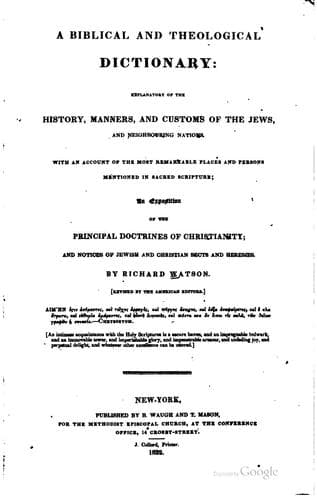
A Biblical and Theological Dictionary: explanatory of the history, manners, and customs of the Jews, and neighbouring nationsWatson, Richard
Religion
A Biblical and Theological Dictionary: explanatory of the history, manners, and customs of the Jews, and neighbouring nations
Watson, Richard
Bible -- Dictionaries; Theology -- Dictionaries
the over-flowing of the Euphrates, and, annually filled, they are not
dried up throughout the year. “Deep cavities are also formed by the
Arabs, when digging for hidden treasure.” Thus “the ground,” says
Buckingham, “is sometimes covered with pools of water in the hollows.”
“Sit in the dust, sit on the ground, O daughter of the Chaldeans.” The
surface of the mounds which form all that remains of Babylon, consists
of decomposed buildings, reduced to dust; and over all the ancient
streets and habitations, there is literally nothing but the dust of the
ground on which to sit.--“Thy nakedness shall be uncovered.” “Our path,”
says Captain Mignan, “lay through the great mass of ruined heaps on the
site of ‘shrunken Babylon;’ and I am perfectly incapable of conveying an
adequate idea of the dreary, lonely nakedness that appeared before
me.”--“Sit thou silent, and get thee into darkness.” “There reigns
throughout the ruins,” says Sir R. K. Porter, “a silence profound as the
grave.” “Babylon is now a silent scene, a sublime solitude.”--“It shall
never be inhabited, nor dwelt in from generation to generation.” From
Rauwolff’s testimony it appears that, in the sixteenth century, “there
was not a house to be seen.” And now “the eye wanders over a barren
desert, in which the ruins are nearly the only indication that it had
ever been inhabited.” “It is impossible,” adds Major Keppel, “to behold
this scene and not to be reminded how exactly the predictions of Isaiah
and Jeremiah have been fulfilled, even in the appearance Babylon was
doomed to present, that ‘she should never be inhabited;’ that ‘the
Arabian should not pitch his tent there;’ that she should ‘become
heaps;’ that her cities should be ‘a desolation, a dry land, and a
wilderness.’” “Babylon is spurned alike by the heel of the Ottomans, the
Israelites, and the sons of Ishmael.” It is “a tenantless and desolate
metropolis,” remarks Mignan. “It shall not be inhabited, but be wholly
desolate. Neither shall the Arabian pitch tent there, neither shall the
shepherds make their folds there.” It was prophesied of Ammon that it
should be a stable for camels and a couching place for flocks; and of
Philistia, that it should be cottages for shepherds, and a pasture of
flocks. But Babylon was to be visited with a far greater desolation, and
to become unfit or unsuited even for such a purpose; and that neither a
tent would be pitched there, even by an Arab, nor a fold made by a
shepherd, implies the last degree of solitude and desolation. “It is
common in these parts for shepherds to make use of ruined edifices to
shelter their flocks in.” But Babylon is an exception. Instead of taking
the bricks from thence, the shepherd might very readily erect a defence
from wild beasts, and make a fold for his flock amidst the heaps of
Babylon; and the Arab who fearlessly traverses it by day, might pitch
his tent by night. But neither the one nor the other could now be
persuaded to remain a single night among the ruins.
Public-domain text, read in full here on John Shaqi.
Reviews
Reviews
No reviews yet
Be the first to share your thoughts on this work.
Elsewhere in the archive
Join the Discussion
Join the discussion
Sign in to leave a comment or review.
Sign InorCreate an account