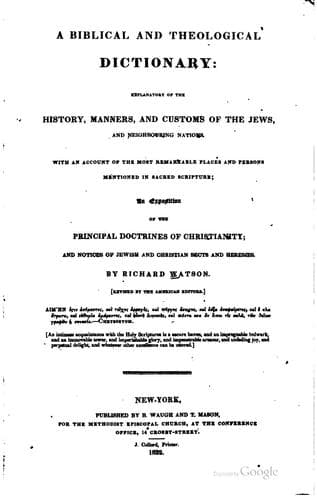
A Biblical and Theological Dictionary: explanatory of the history, manners, and customs of the Jews, and neighbouring nationsWatson, Richard
Religion
A Biblical and Theological Dictionary: explanatory of the history, manners, and customs of the Jews, and neighbouring nations
Watson, Richard
Bible -- Dictionaries; Theology -- Dictionaries
A great part of the back wall, and of the roof,
is broken down; but that which remains “still appears much larger than
Westminster Abbey.” It is supposed to have been the lofty palace of
Chosroes; but there desolation now reigns. “On the site of Ctesiphon,”
says Mignan, “the smallest insect under heaven would not find a single
blade of grass wherein to hide itself, nor one drop of water to allay
its thirst.” In the rear of the palace, and attached to it, are mounds
two miles in circumference, indicating the utter desolation of
buildings, formed to minister to luxury.
5. But let us come to the fulfilment of these wonderful prophecies in
the present condition of Babylon itself, as described by those who have
most recently visited it.
“Babylon shall become heaps.” Babylon the glory of kingdoms is now the
greatest of ruins. “Immense tumuli of temples, palaces, and habitations
of every description,” are every where seen, and form “long and varied
lines of ruins,” which, in some places, says Sir R. K. Porter, “rather
resemble natural hills than _mounds_ which cover the remains of great
and splendid edifices.” These buildings, which were once the labour of
slaves and the pride of kings, are now misshapen heaps of rubbish. “The
whole face of the country,” observes Rich, “is covered with vestiges of
building, in some places consisting of brick walls surprisingly fresh,
in others, merely a _vast succession of mounds_ of rubbish, of such
indeterminate figures, variety, and extent, as to involve the person who
should have formed any theory in inextricable confusion.”--“Let nothing
of her be left.” “Vast heaps constitute _all that now remains_ of
ancient Babylon,” says Rich. All its grandeur is departed; all its
treasures have been spoiled; all its excellence has utterly vanished;
the very heaps are searched for bricks, when nothing else can be found;
even these are _not left_, wherever they can be taken away; and Babylon
has for ages been “a quarry above ground,” ready to the hand of every
successive despoiler. Without the most remote allusion to this prophecy,
Captain Mignan describes a mound attached to the palace, ninety yards in
breadth by half that height, the whole of which is deeply furrowed, in
the same manner as the generality of the mounds. “The ground is
extremely soft, and tiresome to walk over, and appears _completely
exhausted_ of all its building materials; _nothing now is left_, save
one towering hill, the earth of which is mixed with _fragments_ of
broken brick, red varnished pottery, tile, bitumen, mortar, glass,
shells, and pieces of mother of pearl,”--worthless fragments, of no
value to the poorest. “From thence shall she be taken, let nothing of
her be left.” While the workmen “cast her up as heaps” while excavating
for bricks, that they may “take” them “from thence,” and that “nothing
may be left;” they labour more than trebly in the fulfilment of
prophecy: for the numerous and deep excavations form pools of water, on
Public-domain text, read in full here on John Shaqi.
Reviews
Reviews
No reviews yet
Be the first to share your thoughts on this work.
Elsewhere in the archive
Join the Discussion
Join the discussion
Sign in to leave a comment or review.
Sign InorCreate an account