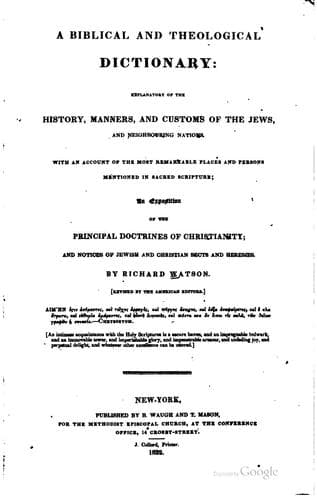
A Biblical and Theological Dictionary: explanatory of the history, manners, and customs of the Jews, and neighbouring nationsWatson, Richard
Religion
A Biblical and Theological Dictionary: explanatory of the history, manners, and customs of the Jews, and neighbouring nations
Watson, Richard
Bible -- Dictionaries; Theology -- Dictionaries
No other improvements have been attempted in this edition of Mr.
Watson’s Biblical and Theological Dictionary, than adding a few notes in
relation to some matters existing in this country, which had escaped the
attention of the author, and rendering those passages and phrases into
English which had been left untranslated. Such translations are included
in brackets. It may be proper to remark, that only that part of the work
from the eight hundred and forty second page has been printed under the
superintendence of the present editor; the former part having passed
through the press previous to the last general conference.
It is not necessary to say any thing in commendation of this work.
Whatever merit, however, may be attached to others of a similar
character which have preceded it, we think it will be conceded by all,
that Mr. Watson, by furnishing this Dictionary, has supplied a
desideratum, in the department of Biblical and Theological literature,
which had long been felt, and for doing which the religious community
will not be backward in acknowledging its obligations.
N. BANGS.
NEW-YORK, _Sept. 25, 1832_.
[Illustration:
The
=WORLD=,
_as Peopled by_
THE =DESCENDANTS= OF
=NOAH=
_Shewing the Countries possessed by_
=SHEM, HAM & JAPHET=
and their posterity
]
A
BIBLICAL AND THEOLOGICAL DICTIONARY.
AARON, the son of Amram and Jochebed, of the tribe of Levi. Aaron was
three years older than his brother Moses; and when God appeared in the
burning bush, Moses having excused himself from the undertaking
committed to him, by urging that he was slow of speech, Aaron, who was
an eloquent man, was made his interpreter and spokesman; and in
effecting the deliverance of the Hebrews we therefore find them
constantly associated. During the march of the children of Israel
through the wilderness, Aaron and his sons were appointed by God to
exercise for ever the office of priests in the tabernacle.
Moses having ascended the mountain to receive the law from God, Aaron,
his sons, and seventy elders, followed him, Exod. xxiv, 1, 2, 9–11; not
indeed to the summit, but “afar off,” “and they saw the God of Israel,”
that is, the glory in which he appeared, “as it were the paved work of a
sapphire stone, and as it were the body of heaven for clearness;”--a
clear and dazzling azure, a pure, unmingled splendour like that of the
heavens. “And upon the nobles of Israel,” Aaron, his sons, and the
seventy elders, “he laid not his hand,”--they were not destroyed by a
sight which must have overwhelmed the weakness of mortal men had they
not been strengthened to bear it; “and they did eat and drink,”--they
joyfully and devoutly feasted before the Lord, as a religious act, upon
the sacrifices they offered. After this they departed, and Moses
remained with God on the very summit of the mount forty days.
Public-domain text, read in full here on John Shaqi.
Reviews
Reviews
No reviews yet
Be the first to share your thoughts on this work.
Join the Discussion
Join the discussion
Sign in to leave a comment or review.
Sign InorCreate an account