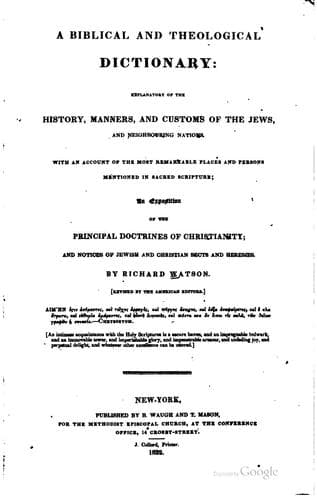
A Biblical and Theological Dictionary: explanatory of the history, manners, and customs of the Jews, and neighbouring nationsWatson, Richard
Religion
A Biblical and Theological Dictionary: explanatory of the history, manners, and customs of the Jews, and neighbouring nations
Watson, Richard
Bible -- Dictionaries; Theology -- Dictionaries
BALAAM, a prophet of the city of Pethor, or Bosor, upon the Euphrates,
whose intercourse with Balak, king of the Moabites, who sent for him to
curse the Israelites, is recorded at large by Moses, Num. xxii-xxiv. It
has been a subject of controversy, whether Balaam was a true prophet or
a mere diviner, magician, or fortune teller. Origen says that his whole
power consisted in magic and cursing. Theodoret is of opinion that
Balaam did not consult the Lord, but that he was supernaturally
inspired, and constrained to speak against his own inclination. Cyril
says that he was a magician, an idolater, and a false prophet, who spoke
truth against his will; and St. Ambrose compares him to Caiaphas, who
prophesied without being aware of the import of what he said. Jerom
seems to have adopted the opinion of the Hebrews; which was, that Balaam
knew the true God, erected altars to him, and that he was a true
prophet, though corrupted by avarice, Num. xxii, 18. St. Austin and
other commentators have inclined to this opinion. Dr. Jortin supposes
that Balaam was a worshipper of the true God, and a priest and prophet
of great reputation; and that he was sent for by Balak from a notion
which generally prevailed, that priests and prophets could sometimes, by
prayers and sacrifices duly and skilfully applied, obtain favours from
God, and that their imprecations were efficacious. He conceives that the
prophet had been accustomed to revelations, and that he used to receive
them in visions, or in dreams of the night. It cannot be denied that the
Scripture expressly calls him a prophet, 2 Pet. ii, 15, and therefore
those are probably right who think that he had once been a good man and
a true prophet, till, loving the wages of unrighteousness, and
prostituting the honour of his office to covetousness, he apostatized
from God, and, betaking himself to idolatrous practices, fell under the
delusion of the devil, of whom he learned all his magical enchantments;
though at this juncture, when the preservation of his people was
concerned, it might be consistent with God’s wisdom to appear to him and
overrule his mind by the impulse of real revelations. As to what passed
between him and his ass, when that animal was miraculously enabled to
speak to its master, commentators are divided in their opinions; whether
it really and literally happened as Moses relates it, or whether it be
an allegory only, or was the mere imagination or vision of Balaam. But
St. Peter evidently mentions it as a fact literally and certainly
occurring: “the dumb ass, speaking with man’s voice, when she forbade
the madness of the prophet,” 2 Pet. ii, 16. This, it is true, has
frequently been made the subject of profane banter by those whose
skepticism leads them to scoff at all prodigies. But how absurd is it to
subject a miraculous event to the ordinary rules of reasoning! “Say what
you will of the formation of the tongue and jaws being unfit for
Public-domain text, read in full here on John Shaqi.
Reviews
Reviews
No reviews yet
Be the first to share your thoughts on this work.
Elsewhere in the archive
Join the Discussion
Join the discussion
Sign in to leave a comment or review.
Sign InorCreate an account