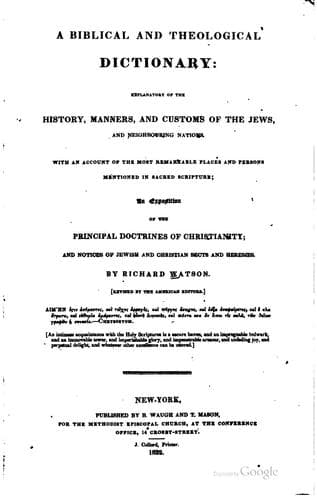
A Biblical and Theological Dictionary: explanatory of the history, manners, and customs of the Jews, and neighbouring nationsWatson, Richard
Religion
A Biblical and Theological Dictionary: explanatory of the history, manners, and customs of the Jews, and neighbouring nations
Watson, Richard
Bible -- Dictionaries; Theology -- Dictionaries
speaking,” says Bishop Newton, “yet an adequate cause is assigned for
this wonderful event; for it is expressly said that ‘the Lord opened the
mouth of the ass;’ and who that believes a God, can doubt his power to
do this and much more? The miracle was by no means needless or
superfluous; it was well adapted to convince Balaam that the mouth and
tongue were under God’s direction, and that the same divine power which
caused the dumb ass to speak contrary to its nature, could, in like
manner, make him utter blessings contrary to his inclination. And,
accordingly, he was overruled to bless the people, though he came
prepared and disposed to curse them; which was the greater miracle of
the two; for the ass was merely passive, but Balaam resisted the good
motions of God.” The prophecy which Balaam delivered concerning Israel
on this remarkable occasion, and which is contained in Numbers xxiv,
5–9, has been greatly admired by critics. Bishop Lowth, in particular,
remarks that he knows nothing in the whole scope of the Hebrew poetry
more exquisite or perfect. “It abounds,” says he, “in splendid imagery,
copied immediately from the tablet of nature; and is chiefly conspicuous
for the glowing elegance of the style, and the form and diversity of the
figures.”
After his predictions, Balaam returned into his own country; but before
he left the land of Moab, as if vexed with his own disappointment in
missing the promised reward, and with a purpose of revenging himself on
the Israelites, as the cause of it, he instructed the Moabites and
Midianites in a wicked scheme, which was to send their daughters into
the camp of the Israelites, in order to draw them first into lewdness,
and then into idolatry, the certain means of depriving them of the help
of that God who protected them. This artifice succeeded; for as the
Israelites lay encamped at Shittim, many of them were deluded by these
strange women, not only to commit whoredom with them, but to assist at
their sacrifices, and worship their god Baal-Peor, Num. xxv, 1–3; xxxi,
16; Mic. vi, 5; 2 Pet. ii, 15; Jude 11; Rev. ii, 14; Deut. xxiii, 4, 5;
Joshua xxiv, 9, 10; Neh. xiii, 2. God commanded Moses to avenge this
crime. He therefore declared war against the Midianites, killed five of
their princes, and a great number of other persons without distinction
of age or sex, among whom was Balaam himself.
Moses says that Balaam consulted the Lord, and calls the Lord his God:
“I cannot go beyond the commandment of the Lord _my_ God,” Num. xxii,
18. The reason why Balaam calls Jehovah, “_my_ God” may be, because he
was of the posterity of Shem, who maintained the worship of Jehovah, not
only in his own person, but among his descendants; so that while the
posterity of Ham fell into idolatry, and the posterity of Japhet were
settled at a distance in Europe, the Shemites generally, though not
universally, retained the worship of God.
Public-domain text, read in full here on John Shaqi.
Reviews
Reviews
No reviews yet
Be the first to share your thoughts on this work.
Elsewhere in the archive
Join the Discussion
Join the discussion
Sign in to leave a comment or review.
Sign InorCreate an account