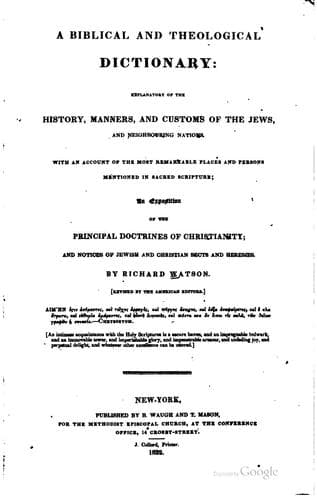
A Biblical and Theological Dictionary: explanatory of the history, manners, and customs of the Jews, and neighbouring nationsWatson, Richard
Religion
A Biblical and Theological Dictionary: explanatory of the history, manners, and customs of the Jews, and neighbouring nations
Watson, Richard
Bible -- Dictionaries; Theology -- Dictionaries
for _curse_: and, strictly speaking, the phrase does not mean _bitter
water_, but the _water of bitternesses_, that is, of curses. The priest
now pronounced the oath, which was in all points so framed that it could
excite no terrors in the breast of an innocent woman; for it expressly
consisted in this, that the imprecation water should not harm her if she
was innocent. It would seem as if the priest here made a stop, and again
left the woman some time to consider whether she would proceed with the
oath. This I infer from the circumstance of his speech not being
directly continued in verse 21st, which is rather the _apodosis_ of what
goes before; and from the detail proceeding anew in the words of the
historian, _Then shall the priest pronounce the rest of the oath and the
curses to the woman; and proceed thus_.--After this stop he pronounced
the curses, and the woman was obliged to declare her acquiescence in
them by a repeated _Amen_. Nor was the solemn scene yet altogether at an
end; but rather, as it were commenced anew. For the priest had yet to
write the curses in a book, which I suppose he did at great
deliberation; having done so, he washed them out again in the very
imprecation water, which the woman had now to drink; and this water
being now presented to her, she was obliged to drink it, with this
warning and assurance, in the name of God, that if she was guilty, it
would prove within her an absolute curse. Now, what must have been her
feelings, while drinking, if not conscious of purity? In my opinion she
must have conceived that she already felt an alteration in the state of
her body, and the germ, as it were, of the disease springing within her.
Conscience and imagination would conspire together, and render it almost
impossible for her to drink it out. Finally, the execration offering was
taken out of her hand, and burnt upon the altar. I cannot but think
that, under the sanction of such a _purgatorium_, perjury must have been
a very rare occurrence indeed. If it happened but once in an age, God
had bound himself to punish it; and if this took place but once, (if but
one woman who had taken the oath was attacked with that rare disease
which it threatened,) it was quite enough to serve as a determent to all
others for at least one generation.”
This procedure had also the effect of keeping in mind, among the Jews,
God’s high displeasure against this violation of his law; and though
some lax moralists have been found, in modern times, to palliate it, yet
the Christian will always remember the solemn denunciations of the New
Testament against a crime so aggravated, whether considered in its
effects upon the domestic relations, upon the moral character of the
guilty parties, or upon society at large,--“Whoremongers and adulterers
God will judge.”
Public-domain text, read in full here on John Shaqi.
Reviews
Reviews
No reviews yet
Be the first to share your thoughts on this work.
Elsewhere in the archive
Join the Discussion
Join the discussion
Sign in to leave a comment or review.
Sign InorCreate an account