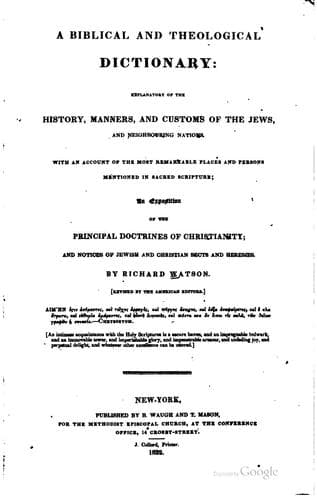
A Biblical and Theological Dictionary: explanatory of the history, manners, and customs of the Jews, and neighbouring nationsWatson, Richard
Religion
A Biblical and Theological Dictionary: explanatory of the history, manners, and customs of the Jews, and neighbouring nations
Watson, Richard
Bible -- Dictionaries; Theology -- Dictionaries
“By one of the clauses of the oath of purgation, (and had not the
legislator been perfectly assured of his divine mission, the insertion
of any such clause would have been a very bold step indeed,) a visible
and corporeal punishment was specified, which the person swearing
imprecated on herself, and which God himself was understood as engaging
to execute. To have given so accurate a definition of the punishment
that God meant to inflict, and still more one that consisted of such a
rare disease, would have been a step of incomprehensible boldness in a
legislator who pretended to have a divine mission, if he was not, with
the most assured conviction, conscious of its reality.
“Seldom, however, very seldom, was it likely that Providence would have
an opportunity of inflicting the punishment in question. For the oath
was so regulated, that a woman of the utmost effrontery could scarcely
have taken it without changing colour to such a degree as to betray
herself.
“In the _first_ place, it was not administered to the woman in her own
house, but she was under the necessity of going to that place of the
land where God in a special manner had his abode, and took it there.
Now, the solemnity of the place, unfamiliarized to her by daily business
or resort, would have a great effect upon her mind. In the _next_ place,
there was offered unto God what was termed an _execration offering_, not
in order to propitiate his mercy, but to invoke his vengeance on the
guilty. Here the process was extremely slow, which gave her more time
for reflection than to a guilty person could be acceptable, and that,
too, amidst a multitude of unusual ceremonies. For the priest conducted
her to the front of the sanctuary, and took holy water, that is, water
out of the priests’ laver, which stood before it, together with some
earth off its floor, which was likewise deemed holy; and having put the
earth in the water, he then proceeded to uncover the woman’s head, that
her face might be seen, and every change on her countenance during the
administration of the oath accurately observed: and this was a
circumstance which, in the east, where the women are always veiled, must
have had a great effect; because a woman, accustomed to wear a veil,
could, on so extraordinary an occasion, have had far less command of her
eyes and her countenance than a European adulteress, who is generally a
perfect mistress in all the arts of dissimulation, would display. To
render the scene still more awful, the tresses of her hair were
loosened, and then the execration offering was put into _her_ hand,
while the priest held in _his_ the imprecation water. This is commonly
termed the _bitter water_; but we must not understand this as if the
water had really been bitter; for how could it have been so? The earth
of the floor of the tabernacle could not make it bitter. Among the
Hebrews, and other oriental nations, the word _bitter_ was rather used
Public-domain text, read in full here on John Shaqi.
Reviews
Reviews
No reviews yet
Be the first to share your thoughts on this work.
Elsewhere in the archive
Join the Discussion
Join the discussion
Sign in to leave a comment or review.
Sign InorCreate an account