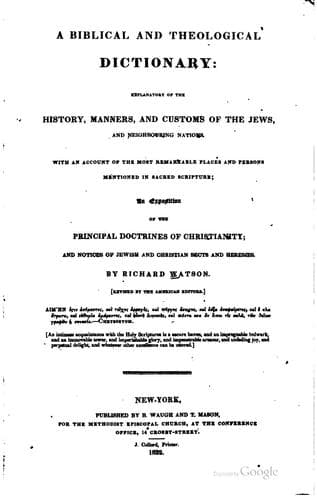
A Biblical and Theological Dictionary: explanatory of the history, manners, and customs of the Jews, and neighbouring nationsWatson, Richard
Religion
A Biblical and Theological Dictionary: explanatory of the history, manners, and customs of the Jews, and neighbouring nations
Watson, Richard
Bible -- Dictionaries; Theology -- Dictionaries
AGAG. This seems to have been a common name of the princes of Amalek,
one of whom was very powerful as early as the time of Moses, Num. xxiv,
7. On account of the cruelties exercised by this king and his army
against the Israelites, as they returned from Egypt, a bloody and long
contested battle took place between Joshua and the Amalekites, in which
the former was victorious, Exod. xvii, 8–13. At the same time, God
protested with an oath to destroy Amalek, verses 14–16; Deut. xxv,
17–19, A. M. 2513. About four hundred years after this, the Lord
remembered the cruel treatment of his people, and his own oath; and he
commanded Saul, by the mouth of Samuel, to destroy the Amalekites. Saul
mustered his army, and found it two hundred thousand strong, 1 Sam. xv,
1, &c. Having entered into their country, he cut in pieces all he could
meet with from Havilah to Shur. Agag their king, and the best of their
cattle, were however spared, an act of disobedience on the part of Saul,
probably dictated by covetousness. But Agag did not long enjoy this
reprieve; for Samuel no sooner heard that he was alive, than he sent for
him; and notwithstanding his insinuating address, and the vain hopes
with which he flattered himself that the bitterness of death was past,
he caused him to be hewed to pieces in Gilgal before the Lord, saying,
“As, כאשר, _in the same identical mode as_, thy sword hath made women
childless, so shall thy mother be childless among women.” This savage
chieftain had hewed many prisoners to death; and, therefore, by command
of the Judge of the whole earth, he was visited with the same punishment
which he had inflicted upon others.
AGAPÆ. See LOVE FEAST.
AGAR, mount Sinai, so called, Gal. iv, 24, 25. But this reading is
doubtful, many MSS. having the verse, “for this Sinai is a mountain of
Arabia.” Some critics however contend for the reading of the received
text, and urge that _Agar_, which signifies “a rocky mountain,” is the
Arabic name for _Sinai_.
AGATE, שבו, Exod. xxviii, 19; xxxix, 12. In the Septuagint ἀχάτης, and
Vulgate, _achates_. A precious stone, semi-pellucid. Its variegations
are sometimes most beautifully disposed, representing plants, trees,
rivers, clouds, &c. Its Hebrew name is, perhaps, derived from the
country whence the Jews imported it; for the merchants of Sheba brought
to the market of Tyre all kinds of precious stones, Ezek. xxvii, 22. The
agate was the second stone in the third row of the pectoral of the high
priest, Exod. xxviii, 19, and xxxix, 12.
Public-domain text, read in full here on John Shaqi.
Reviews
Reviews
No reviews yet
Be the first to share your thoughts on this work.
Elsewhere in the archive
Join the Discussion
Join the discussion
Sign in to leave a comment or review.
Sign InorCreate an account