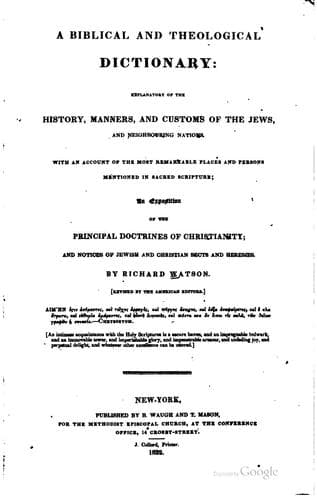
A Biblical and Theological Dictionary: explanatory of the history, manners, and customs of the Jews, and neighbouring nationsWatson, Richard
Religion
A Biblical and Theological Dictionary: explanatory of the history, manners, and customs of the Jews, and neighbouring nations
Watson, Richard
Bible -- Dictionaries; Theology -- Dictionaries
AGE, in the most general sense of the term, denotes the duration of any
substance, animate or inanimate; and is applied either to the whole
period of its existence, or to that portion of it which precedes the
time to which the description of it refers. In this sense it is used to
signify either the whole natural duration of the LIFE of man, or any
interval of it that has elapsed before the period of which we speak.
When age is understood of a certain portion of the life of man, its
whole duration is divided into four different ages, viz. infancy, youth,
manhood, and old age: the first extending to the fourteenth year; the
second, denominated youth, adolescence, or the age of puberty,
commencing at fourteen, and terminating at about twenty-five; manhood,
or the virile age, concluding at fifty; and the last ending at the close
of life. Some divide the first period into infancy and childhood; and
the last likewise into two stages, calling that which succeeds the age
of seventy-five, decrepit old age. Age is applicable to the duration of
things inanimate or factitious; and in this use of the term we speak of
the age of a house, of a country, of a state or kingdom, &c.
AGE, in _chronology_, is used for a century, or a period of one hundred
years: in which sense it is the same with _seculum_, and differs from
_generation_. It is also used in speaking of the times past since the
creation of the world. The several ages of the world may be reduced to
three grand epochas, viz. the age of the law of nature, called by the
Jews the void age, from Adam to Moses. The age of the Jewish law, from
Moses to Christ, called by the Jews the present age. And the age of
grace, from Christ to the present year. The Jews call the third age, the
age to come, or the future age; denoting by it the time from the advent
of the Messiah to the end of the world. The Romans distinguished the
time that preceded them into three ages: the obscure or uncertain age,
which reached down as low as Ogyges king of Attica, in whose reign the
deluge happened in Greece; the fabulous or heroic age, which ended at
the first olympiad; and the historical age, which commenced at the
building of Rome. Among the poets, the four ages of the world are, the
golden, the silver, the brazen, and the iron age.
Age is sometimes used among the ancient poets in the same sense as
_generation_, or a period of thirty years. Thus Nestor is said to have
lived three ages, when he was ninety years old.
Public-domain text, read in full here on John Shaqi.
Reviews
Reviews
No reviews yet
Be the first to share your thoughts on this work.
Elsewhere in the archive
Join the Discussion
Join the discussion
Sign in to leave a comment or review.
Sign InorCreate an account