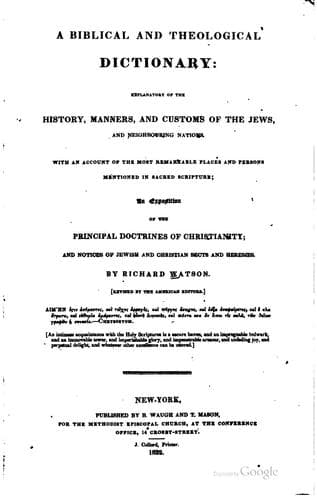
A Biblical and Theological Dictionary: explanatory of the history, manners, and customs of the Jews, and neighbouring nationsWatson, Richard
Religion
A Biblical and Theological Dictionary: explanatory of the history, manners, and customs of the Jews, and neighbouring nations
Watson, Richard
Bible -- Dictionaries; Theology -- Dictionaries
additions to that book every where call the husband of Esther
Artaxerxes; and he could be no other than Artaxerxes Longimanus. The
extraordinary favour shown to the Jews by this king, first in sending
Ezra, and afterward Nehemiah, to relieve this people, and restore them
to their ancient prosperity, affords strong presumptive evidence that
they had near his person and high in his regard such an advocate as
Esther. Ahasuerus is also a name given in Scripture, Ezra iv, 6, to
Cambyses, the son of Cyrus; and to Astyages, king of the Medes, Dan. ix,
1.
AHAVA. The name of a river of Babylonia, or rather of Assyria, where
Ezra assembled those captives whom he afterward brought into Judea, Ezra
viii, 15. The river Ahava is thought to be that which ran along the
Adabene, where a river Diava, or Adiava, is mentioned, and on which
Ptolemy places the city Abane or Aavane. This is probably the country
called Ava, whence the kings of Assyria translated the people called
Avites into Palestine, and where they settled some of the captive
Israelites, 2 Kings xvii, 24; xviii, 34; xix, 13; xvii, 31. Ezra,
intending to collect as many Israelites as he could, who might return to
Judea, halted in the country of Ava, or Aahava, whence he sent agents
into the Caspian mountains, to invite such Jews as were willing to join
him, Ezra viii, 16. The history of Izates, king of the Adiabenians, and
of his mother Helena, who became converts to Judaism some years after
the death of Jesus Christ, sufficiently proves that there were many Jews
still settled in that country.
AHAZ succeeded his father Jotham, as king of Israel, at the age of
twenty years, reigned till the year before Christ, 726, and addicted
himself to the practice of idolatry. After the customs of the Heathen,
he made his children to pass through fire; he shut up the temple, and
destroyed its vessels. He became tributary to Tiglath-pileser, whose
assistance he supplicated against the kings of Syria and Israel. Such
was his impiety, that he was not allowed burial in the sepulchres of the
kings of Israel, 2 Kings xvi; 2 Chron. xxviii.
Public-domain text, read in full here on John Shaqi.
Reviews
Reviews
No reviews yet
Be the first to share your thoughts on this work.
Elsewhere in the archive
Join the Discussion
Join the discussion
Sign in to leave a comment or review.
Sign InorCreate an account