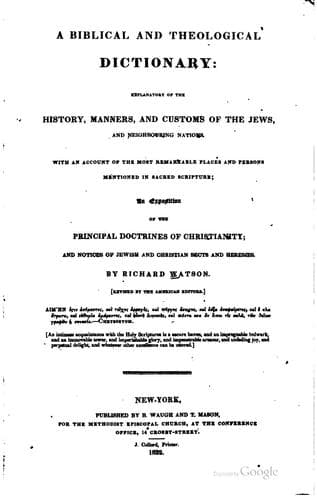
A Biblical and Theological Dictionary: explanatory of the history, manners, and customs of the Jews, and neighbouring nationsWatson, Richard
Religion
A Biblical and Theological Dictionary: explanatory of the history, manners, and customs of the Jews, and neighbouring nations
Watson, Richard
Bible -- Dictionaries; Theology -- Dictionaries
the names Agur and Lemuel in support of the conjecture, that they are
appellations of Solomon. The contents, likewise, of the two chapters in
question strongly militate against this hypothesis.
When all these circumstances are taken into consideration, together with
the extreme improbability that Solomon should be denominated three times
by his proper name, and afterward, in the same work, by two different
enigmatical names, we are fully warranted in rejecting the notion, that
the wise monarch is designed by the appellations Agur and Lemuel. And it
seems most reasonable to consider them as denoting real persons.
AHAB, the son and successor of Omri. He began his reign over Israel, A.
M. 3086, and reigned 22 years. In impiety he far exceeded all the kings
of Israel. He married Jezebel, the daughter of Ethbaal, king of Zidon,
who introduced the whole abominations and idols of her country, Baal and
Ashtaroth.
2. AHAB the son of Kolaiah, and Zedekiah the son of Maaseiah, were two
false prophets, who, about A. M. 3406, seduced the Jewish captives at
Babylon with hopes of a speedy deliverance, and stirred them up against
Jeremiah. The Lord threatened them with a public and ignominious death,
before such as they had deceived; and that their names should become a
curse; men wishing that their foes might be made like Ahab and Zedekiah,
whom Nebuchadnezzar king of Babylon roasted in the fire, Jer. xxix, 21,
22.
AHASUERUS was the king of Persia, who advanced Esther to be queen, and
at her request delivered the Jews from the destruction plotted for them
by Haman. Archbishop Usher is of opinion that this Ahasuerus was Darius
Hystaspes; and that Atossa was the Vashti, and Artystona the Esther, of
the Scriptures. But, according to Herodotus, the latter was the daughter
of Cyrus, and therefore could not be Esther; and the former had four
sons by Darius, besides daughters, born to him after he was king; and
therefore she could not be the queen Vashti, divorced from her husband
in the third year of his reign, nor he the Ahasuerus who divorced her.
Besides, Atossa retained her influence over Darius to his death, and
obtained the succession of the crown for his son, Xerxes; whereas Vashti
was removed from the presence of Ahasuerus by an irrevocable decree,
Esther i, 19. Joseph Scaliger maintains that Xerxes was the Ahasuerus,
and Hamestris his queen, the Esther, of Scripture. The opinion is
founded on the similitude of names, but contradicted by the
dissimilitude of the characters of Hamestris and Esther. Besides,
Herodotus says that Xerxes had a son by Hamestris that was marriageable
in the seventh year of his reign; and therefore she could not be Esther.
The Ahasuerus of Scripture, according to Dr. Prideaux, was Artaxerxes
Longimanus. Josephus positively says that this was the person. The
Septuagint, through the whole book of Esther, uses Artaxerxes for the
Hebrew Ahasuerus wherever the appellation occurs; and the apocryphal
Public-domain text, read in full here on John Shaqi.
Reviews
Reviews
No reviews yet
Be the first to share your thoughts on this work.
Elsewhere in the archive
Join the Discussion
Join the discussion
Sign in to leave a comment or review.
Sign InorCreate an account