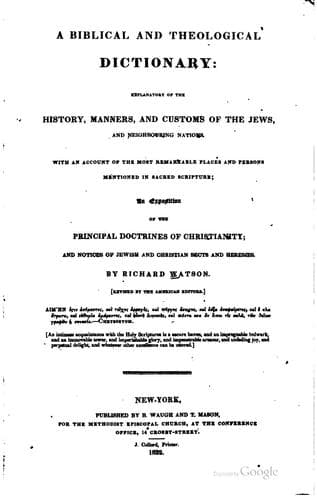
A Biblical and Theological Dictionary: explanatory of the history, manners, and customs of the Jews, and neighbouring nationsWatson, Richard
Religion
A Biblical and Theological Dictionary: explanatory of the history, manners, and customs of the Jews, and neighbouring nations
Watson, Richard
Bible -- Dictionaries; Theology -- Dictionaries
AHIMELECH. He was the son of Ahitub, and brother of Ahia, whom he
succeeded in the high priesthood. He is called Abiathar, Mark ii, 26.
During his priesthood the tabernacle was at Nob, where Ahimelech, with
other priests, had their habitation. David, being informed by his friend
Jonathan that Saul was determined to destroy him, thought it prudent to
retire. He therefore went to Nob, to the high priest Ahimelech, who gave
him the shew bread, and the sword of Goliath. One day, when Saul was
complaining of his officers, that no one was affected with his
misfortunes, or gave him any intelligence of what was carrying on
against him, 1 Sam. xxii, 9, &c, Doeg related to him what had occurred
when David came to Ahimelech the high priest. On this information, Saul
convened the priests, and having charged them with the crime of treason,
ordered his guards to slay them, which they refusing to do, Doeg, who
had been their accuser, at the king’s command became their executioner,
and with his sacrilegious hand massacred no less than eighty-five of
them; the Septuagint and Syriac versions make the number of priests
slain by Doeg three hundred and five. Nor did Saul stop here; but,
sending a party to Nob, he commanded them to slay men, women, and
children, and even cattle, with the edge of the sword. Only one son of
Ahimelech, named Abiathar, escaped the carnage and fled to David.
AHITHOPHEL, a native of Giloh, who, after having been David’s
counsellor, joined in the rebellion of Absalom, and assisted him with
his advice. Hushai, the friend of David, was employed to counteract the
counsels of Ahithophel, and to deprive Absalom, under a pretence of
serving him, of the advantage that was likely to result from the
measures which he proposed. One of these measures was calculated to
render David irreconcilable, and was immediately adopted; and the other
to secure, or to slay him. Before the last counsel was followed,
Hushai’s advice was desired; and he recommended their assembling
together the whole force of Israel, putting Absalom at their head, and
overwhelming David by their number. The treacherous counsel of Hushai
was preferred to that of Ahithophel; with which the latter being
disgusted he hastened to his house at Giloh, where he put an end to his
life. He probably foresaw Absalom’s defeat, and dreaded the punishment
which would be inflicted on himself as a traitor, when David was
resettled on the throne. A. M. 2981. B. C. 1023. 2 Sam. xv, xvii.
Public-domain text, read in full here on John Shaqi.
Reviews
Reviews
No reviews yet
Be the first to share your thoughts on this work.
Elsewhere in the archive
Join the Discussion
Join the discussion
Sign in to leave a comment or review.
Sign InorCreate an account