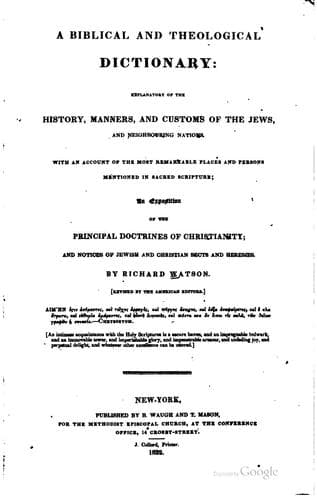
A Biblical and Theological Dictionary: explanatory of the history, manners, and customs of the Jews, and neighbouring nationsWatson, Richard
Religion
A Biblical and Theological Dictionary: explanatory of the history, manners, and customs of the Jews, and neighbouring nations
Watson, Richard
Bible -- Dictionaries; Theology -- Dictionaries
AHOLIBAH. This and Aholah are two feigned names made use of by Ezekiel,
xxiii, 4, to denote the two kingdoms of Judah and Samaria. Aholah and
Aholibah are represented as two sisters of Egyptian extraction. Aholah
stands for Samaria, and Aholibah for Jerusalem. The first signifies a
_tent_, and the second, _my tent is in her_. They both prostituted
themselves to the Egyptians and Assyrians, in imitating their
abominations and idolatries; for which reason the Lord abandoned them to
those very people for whose evil practices they had shown so passionate
an affection. They were carried into captivity, and reduced to the
severest servitude.
AI, called by the LXX, Gai, by Josephus Aina, and by others Ajah, a town
of Palestine, situate west of Bethel, and at a small distance north-west
of Jericho. The three thousand men, first sent by Joshua to reduce this
city, were repulsed, on account of the sin of Achan, who had violated
the anathema pronounced against Jericho, by appropriating a part of the
spoil. After the expiation of this offence, the whole army of Israel
marched against Ai, with orders to treat that city as Jericho had been
treated, with this difference, that the plunder was to be given to the
army. Joshua, having appointed an ambush of thirty thousand men, marched
against the city, and by a feigned retreat, drew out the king of Ai with
his troops; and upon a signal given by elevating his shield on the top
of a pike, the men in ambush entered the city and set fire to it. Thus
the soldiers of Ai, placed between two divisions of Joshua’s army, were
all destroyed; the king alone being preserved for a more ignominious
death on a gibbet, where he hung till sunset. The spoil of the place was
afterward divided among the Israelites. The men appointed for ambush
are, in one place, said to be thirty thousand, and in another five
thousand. For reconciling this apparent contradiction, most commentators
have generally supposed, that there were two bodies placed in ambuscade
between Bethel and Ai, one of twenty-five thousand and the other of five
thousand men; the latter being probably a detachment from the thirty
thousand first sent, and ordered to lie as near to the city as possible.
Masius allows only five thousand men for the ambuscade, and twenty-five
thousand for the attack.
Public-domain text, read in full here on John Shaqi.
Reviews
Reviews
No reviews yet
Be the first to share your thoughts on this work.
Elsewhere in the archive
Join the Discussion
Join the discussion
Sign in to leave a comment or review.
Sign InorCreate an account