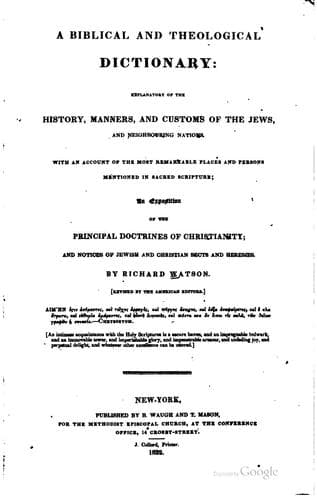
A Biblical and Theological Dictionary: explanatory of the history, manners, and customs of the Jews, and neighbouring nationsWatson, Richard
Religion
A Biblical and Theological Dictionary: explanatory of the history, manners, and customs of the Jews, and neighbouring nations
Watson, Richard
Bible -- Dictionaries; Theology -- Dictionaries
After subduing Syria, Alexander came to Tyre; and the Tyrians refusing
him entrance into their city, he besieged it. At the same time he wrote
to Jaddus, high priest of the Jews, that he expected to be acknowledged
by him, and to receive from him the same submission which had hitherto
been paid to the king of Persia. Jaddus refusing to comply under the
plea of having sworn fidelity to Darius, Alexander resolved to march
against Jerusalem, when he had reduced Tyre. After a long siege, this
city was taken and sacked; and Alexander entered Palestine, A. M. 3672,
and subjected it to his obedience. As he was marching against Jerusalem,
the Jews became greatly alarmed, and had recourse to prayers and
sacrifices. The Lord, in a dream, commanded Jaddus to open the gates to
the conqueror, and, at the head of his people, dressed in his pontifical
ornaments, and attended by the priests in their robes, to advance and
meet the Macedonian king. Jaddus obeyed; and Alexander perceiving this
company approaching, hastened toward the high priest, whom he saluted.
He then adored God, whose name was engraven on a thin plate of gold,
worn by the high priest upon his forehead. The kings of Syria who
accompanied him, and the great officers about Alexander, could not
comprehend the meaning of his conduct. Parmenio alone ventured to ask
him why he adored the Jewish high priest; Alexander replied, that he
paid this respect to God, and not to the high priest. “For,” added he,
“whilst I was yet in Macedonia, I saw the God of the Jews, who appeared
to me in the same form and dress as the high priest at present, and who
encouraged me and commanded me to march boldly into Asia, promising that
he would be my guide, and give me the empire of the Persians. As soon,
therefore, as I perceived this habit, I recollected the vision, and
understood that my undertaking was favoured by God, and that under his
protection I might expect prosperity.”
Having said this, Alexander accompanied Jaddus to Jerusalem, where he
offered sacrifices in the temple according to the directions of the high
priest. Jaddus is said to have showed him the prophecies of Daniel, in
which the destruction of the Persian empire by Alexander is declared.
The king was therefore confirmed in his opinion, that God had chosen him
to execute this great work. At his departure, Alexander bade the Jews
ask of him what they would. The high priest desired only the liberty of
living under his government according to their own laws, and an
exemption from tribute every seventh year, because in that year the Jews
neither tilled their grounds, nor reaped their fruits. With this request
Alexander readily complied.
Public-domain text, read in full here on John Shaqi.
Reviews
Reviews
No reviews yet
Be the first to share your thoughts on this work.
Elsewhere in the archive
Join the Discussion
Join the discussion
Sign in to leave a comment or review.
Sign InorCreate an account