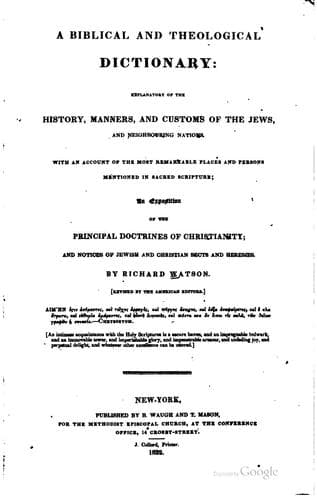
A Biblical and Theological Dictionary: explanatory of the history, manners, and customs of the Jews, and neighbouring nationsWatson, Richard
Religion
A Biblical and Theological Dictionary: explanatory of the history, manners, and customs of the Jews, and neighbouring nations
Watson, Richard
Bible -- Dictionaries; Theology -- Dictionaries
ALABASTER, Ἀλάβαϛρον, the name of a genus of fossils nearly allied to
marble. It is a bright elegant stone, sometimes of a snowy whiteness. It
may be cut freely, and is capable of a fine polish; and, being of a soft
nature, it is wrought into any form or figure with ease. Vases or
cruises were anciently made of it, wherein to preserve odoriferous
liquors and ointments. Pliny and others represent it as peculiarly
proper for this purpose; and the druggists in Egypt have, at this day,
vessels made of it, in which they keep their medicines and perfumes.
In Matt. xxvi, 6, 7, we read that Jesus being at table in Bethany, in
the house of Simon the leper, a woman came thither and poured an
alabaster box of ointment on his head. St. Mark adds, “She brake the
box,” which merely refers to the seal upon the vase which closed it, and
kept the perfume from evaporating. This had never been removed, but was
on this occasion broken, that is, first opened.
ALBIGENSES. See WALDENSES.
ALEPH, א, the name of the first letter in the Hebrew alphabet, from
which the alpha of the Syrians and Greeks was formed. This word
signifies, _prince_, _chief_, or _thousand_, expressing, as it were, a
leading number.
ALEXANDER, commonly called the Great, son and successor of Philip, king
of Macedon, is denoted in the prophecies of Daniel by a leopard with
four wings, signifying his great strength, and the unusual rapidity of
his conquests, Dan. vii, 6; and by a one-horned he-goat running over the
earth so swiftly as not to touch it, attacking a ram with two horns,
overthrowing him, and trampling him under foot, without any being able
to rescue him, Dan. viii, 4–7. The he-goat prefigured Alexander; the
ram, Darius Codomannus, the last of the Persian kings. In the statue
beheld by Nebuchadnezzar in his dream, Dan. ii, 39, the belly of brass
was the emblem of Alexander. He was appointed by God to destroy the
Persian empire, and to substitute in its room the Grecian monarchy.
Alexander succeeded his father Philip, A. M. 3668, and B. C. 336. He was
chosen, by the Greeks, general of their troops against the Persians, and
entered Asia at the head of thirty-four thousand men, A. M. 3670. In one
campaign, he subdued almost all Asia Minor; and afterward defeated, in
the narrow passes which led from Syria to Cilicia, the army of Darius,
which consisted of four hundred thousand foot, and one hundred thousand
horse. Darius fled, and left in the hands of the conqueror, his camp,
baggage, children, wife, and mother.
Public-domain text, read in full here on John Shaqi.
Reviews
Reviews
No reviews yet
Be the first to share your thoughts on this work.
Elsewhere in the archive
Join the Discussion
Join the discussion
Sign in to leave a comment or review.
Sign InorCreate an account