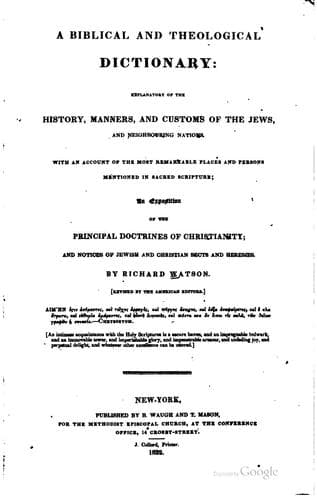
A Biblical and Theological Dictionary: explanatory of the history, manners, and customs of the Jews, and neighbouring nationsWatson, Richard
Religion
A Biblical and Theological Dictionary: explanatory of the history, manners, and customs of the Jews, and neighbouring nations
Watson, Richard
Bible -- Dictionaries; Theology -- Dictionaries
Alexander, after defeating Darius in a pitched battle, and subduing all
Asia and the Indies with incredible rapidity, gave himself up to
intemperance. Having drunk to excess, he fell sick and died, after he
had obliged “all the world to be quiet before him,” 1 Macc. i, 3. Being
sensible that his end was near, he sent for the grandees of his court,
and declared that “he gave the empire to the most deserving.” Some
affirm that he regulated the succession by a will. The author of the
first book of Maccabees says, that he divided his kingdom among his
generals while he was living, 1 Macc. i, 7. This he might do; or he
might express his foresight of what actually took place after his death.
It is certain, that a partition was made of Alexander’s dominions among
the four principal officers of his army, and that the empire which he
founded in Asia subsisted for many ages. Alexander died, A. M. 3684, and
B. C. 323, in the thirty-third year of his age, and the twelfth of his
reign. The above particulars of Alexander are here introduced because,
from his invasion of Palestine, the intercourse of the Jews with the
Greeks became intimate, and influenced many events of their subsequent
history.
On the account above given of the interview between Alexander and the
Jewish high priest, by Josephus, many doubts have been cast by critics.
But the sudden change of his feelings toward them, and the favour with
which the nation was treated by him, render the story not improbable.
ALEXANDRIA, a famous city of Egypt, and, during the reign of the
Ptolemies, the regal capital of that kingdom. It was founded by
Alexander the Great: who being struck with the advantageous situation of
the spot where the city afterward stood, ordered its immediate erection;
drew the plan of the city himself, and peopled it with colonies of
Greeks and Jews: to which latter people, in particular, he gave great
encouragement. They were, in fact, made free citizens, and had all the
privileges of Macedonians granted to them; which liberal policy
contributed much to the rise and prosperity of the new city; for this
enterprising and commercial people knew much better than either the
Greeks or the Egyptians how to turn the happy situation of Alexandria to
the best account. The fall of Tyre happening about the same time, the
trade of that city was soon drawn to Alexandria, which became the centre
of commercial intercourse between the east and the west; and in process
of time grew to such an extent, in magnitude and wealth, as to be second
in point of population and magnificence to none but Rome itself.
Public-domain text, read in full here on John Shaqi.
Reviews
Reviews
No reviews yet
Be the first to share your thoughts on this work.
Elsewhere in the archive
Join the Discussion
Join the discussion
Sign in to leave a comment or review.
Sign InorCreate an account