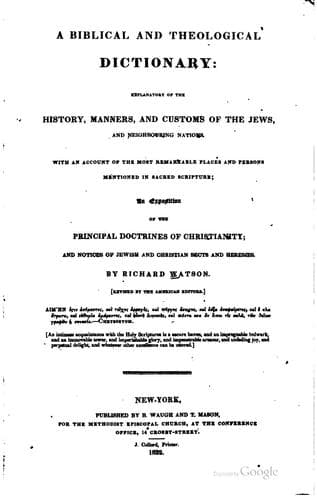
A Biblical and Theological Dictionary: explanatory of the history, manners, and customs of the Jews, and neighbouring nationsWatson, Richard
Religion
A Biblical and Theological Dictionary: explanatory of the history, manners, and customs of the Jews, and neighbouring nations
Watson, Richard
Bible -- Dictionaries; Theology -- Dictionaries
Alexandria owed much of its celebrity as well as its population to the
Ptolemies. Ptolemy Soter, one of Alexander’s captains, who, after the
death of this monarch, was first governor of Egypt, and afterward
assumed the title of king, made this city the place of his residence,
about B. C. 304. This prince founded an academy, called the Museum, in
which a society of learned men devoted themselves to philosophical
studies, and the improvement of all the other sciences; and he also gave
them a library, which was prodigiously increased by his successors. He
likewise induced the merchants of Syria and Greece to reside in this
city, and to make it a principal mart of their commerce. His son and
successor, Ptolemy Philadelphus, pursued the designs of his father.
In the hands of the Romans, the successors of the Macedonians in the
government of Egypt, the trade of Alexandria continued to flourish,
until luxury and licentiousness paved the way, as in every similar
instance, for its overthrow.
Alexandria, together with the rest of Egypt, passed from the dominion of
the Romans to that of the Saracens. With this event, the sun of
Alexandria may be said to have set: the blighting hand of Islamism was
laid on it; and although the genius and the resources of such a city
could not be immediately destroyed, it continued to languish until the
passage by the Cape of Good Hope, in the fifteenth century, gave a new
channel to the trade which for so many centuries had been its support;
and at this day, Alexandria, like most eastern cities, presents a mixed
spectacle of ruins and wretchedness,--of fallen greatness and enslaved
human beings.
Some idea may be formed of the extent and grandeur of Alexandria, by the
boast made by Amrou: “I have taken,” said he, “the great city of the
west. It is impossible for me to enumerate the variety of its riches and
beauty. I shall content myself with observing, that it contains four
thousand palaces, four thousand baths, four hundred theatres or places
of amusement, twelve thousand shops for the sale of vegetable foods, and
forty thousand tributary Jews.”
Public-domain text, read in full here on John Shaqi.
Reviews
Reviews
No reviews yet
Be the first to share your thoughts on this work.
Elsewhere in the archive
Join the Discussion
Join the discussion
Sign in to leave a comment or review.
Sign InorCreate an account