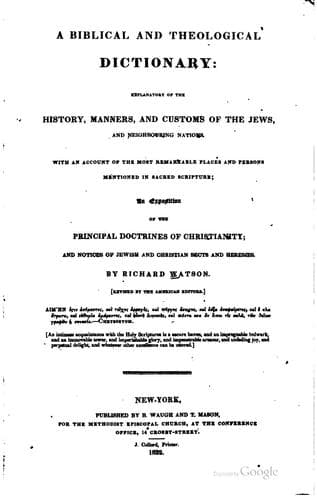
A Biblical and Theological Dictionary: explanatory of the history, manners, and customs of the Jews, and neighbouring nationsWatson, Richard
Religion
A Biblical and Theological Dictionary: explanatory of the history, manners, and customs of the Jews, and neighbouring nations
Watson, Richard
Bible -- Dictionaries; Theology -- Dictionaries
heterogeneous mass of opinions, under the name of the _Eclectic
philosophy_, and which was the foundation of endless confusion, error,
and absurdity, not only in the Alexandrian school, but among Jews and
Christians; producing among the former that specious kind of philosophy,
which they called their _Cabala_, and among the latter innumerable
corruptions of the Christian faith.
At Alexandria there was, in a very early period of the Christian æra, a
Christian school of considerable eminence. St. Jerome says, the school
at Alexandria had been in being from the time of St. Mark. Pantænus,
placed by Lardner at the year 192, presided in it. St. Clement of
Alexandria succeeded Pantænus in this school about the year 190; and he
was succeeded by Origen. The extensive commerce of Alexandria, and its
proximity to Palestine, gave an easy entrance to the new religion, and
when Adrian visited Egypt, he found a church composed of Jews and
Greeks, sufficiently important to attract the notice of that inquisitive
prince. The theological system of Plato was introduced into both the
philosophical and Christian schools of Alexandria; and of course many of
his sentiments and expressions were blended with the opinions and
language of the professors and teachers of Christianity.
Alexandria was the source, and for some time the principal stronghold,
of Arianism; which had its name from its founder, Arius, a presbyter of
the church of this city, about the year 315. His doctrines were
condemned by a council held here in the year 320; and afterward by a
general council of three hundred and eighty fathers, held at Nice, by
order of Constantine, in 325. These doctrines, however, which suited the
reigning taste for disputative theology, and the pride and
self-sufficiency of nominal Christians, better than the unsophisticated
simplicity of the Gospel, spread widely and rapidly notwithstanding.
Arius was steadfastly opposed by the celebrated Athanasius, bishop of
Alexandria, the intrepid champion of the catholic faith, who was raised
to the archiepiscopal throne of Alexandria in 326.
This city was, in 415, distinguished by a fierce persecution of the Jews
by the patriarch Cyril. They who had enjoyed the rights of citizens, and
the freedom of religious worship, for seven hundred years, ever since
the foundation of the city, incurred the hatred of this ecclesiastic;
who, in his zeal for the extermination of heretics of every kind, pulled
down their synagogues, plundered their property, and expelled them, to
the number of forty thousand, from the city.
It was in a ship belonging to the port of Alexandria, that St. Paul
sailed from Myra, a city of Lycia, on his way to Rome, Acts xxvii, 5, 6.
Alexandria was also the native place of Apollos.
Public-domain text, read in full here on John Shaqi.
Reviews
Reviews
No reviews yet
Be the first to share your thoughts on this work.
Elsewhere in the archive
Join the Discussion
Join the discussion
Sign in to leave a comment or review.
Sign InorCreate an account