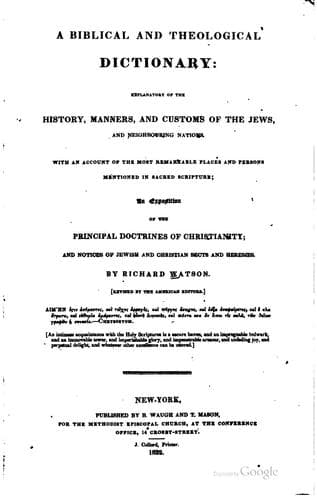
A Biblical and Theological Dictionary: explanatory of the history, manners, and customs of the Jews, and neighbouring nationsWatson, Richard
Religion
A Biblical and Theological Dictionary: explanatory of the history, manners, and customs of the Jews, and neighbouring nations
Watson, Richard
Bible -- Dictionaries; Theology -- Dictionaries
It was in Alexandria chiefly that the Grecian philosophy was engrafted
upon the stock of ancient oriental wisdom. The Egyptian method of
teaching by allegory was peculiarly favourable to such a union: and we
may well suppose that when Alexander, in order to preserve by the arts
of peace that extensive empire which he had obtained by the force of
arms, endeavoured to incorporate the customs of the Greeks with those of
the Persian, Indian, and other eastern nations, the opinions as well as
the manners of this feeble and obsequious race would, in a great
measure, be accommodated to those of their conquerors. This influence of
the Grecian upon the oriental philosophy continued long after the time
of Alexander, and was one principal occasion of the confusion of
opinions which occurs in the history of the Alexandrian and Christian
schools. Alexander, when he built the city of Alexandria, with a
determination to make it the seat of his empire, and peopled it with
emigrants from various countries, opened a new mart of philosophy, which
emulated the fame of Athens itself. A general indulgence was granted to
the promiscuous crowd assembled in this rising city, whether Egyptians,
Grecians, Jews, or others, to profess their respective systems of
philosophy without molestation. The consequence was, that Egypt was soon
filled with religious and philosophical sectaries of every kind; and
particularly, that almost every Grecian sect found an advocate and
professor in Alexandria. The family of the Ptolemies, as we have seen,
who after Alexander obtained the government of Egypt, from motives of
policy encouraged this new establishment. Ptolemy Lagus, who had
obtained the crown of Egypt by usurpation, was particularly careful to
secure the interest of the Greeks in his favour, and with this view
invited people from every part of Greece to settle in Egypt, and removed
the schools of Athens to Alexandria. This enlightened prince spared no
pains to raise the literary, as well as the civil, military, and
commercial credit of his country. Under the patronage first of the
Egyptian princes, and afterward of the Roman emperors, Alexandria long
continued to enjoy great celebrity as the seat of learning, and to send
forth eminent philosophers of every sect to distant countries. It
remained a school of learning, as well as a commercial emporium, till it
was taken, and plundered of its literary treasures by the Saracens.
Philosophy, during this period, suffered a grievous corruption from the
attempt which was made by philosophers of different sects and countries,
Grecian, Egyptian, and oriental, who were assembled in Alexandria, to
frame, from their different tenets, one general system of opinions. The
respect which had long been universally paid to the schools of Greece,
and the honours with which they were now adorned by the Egyptian
princes, induced other wise men, and even the Egyptian priests and
philosophers themselves, to submit to this innovation. Hence arose a
Public-domain text, read in full here on John Shaqi.
Reviews
Reviews
No reviews yet
Be the first to share your thoughts on this work.
Elsewhere in the archive
Join the Discussion
Join the discussion
Sign in to leave a comment or review.
Sign InorCreate an account