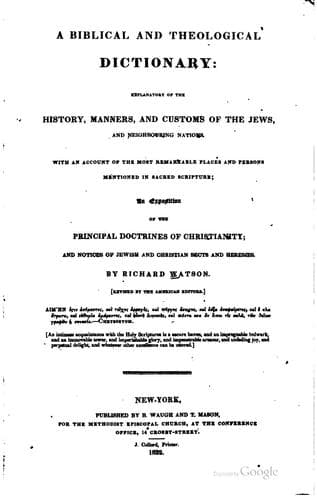
A Biblical and Theological Dictionary: explanatory of the history, manners, and customs of the Jews, and neighbouring nationsWatson, Richard
Religion
A Biblical and Theological Dictionary: explanatory of the history, manners, and customs of the Jews, and neighbouring nations
Watson, Richard
Bible -- Dictionaries; Theology -- Dictionaries
Amrou was inclined to gratify his wish, but his rigid integrity scrupled
to alienate the least object without the consent of the caliph. He
accordingly wrote to Omar, whose well known answer was dictated by the
ignorance of a fanatic: “If these writings of the Greeks agree with the
Koran, or book of God, they are useless, and need not be preserved; if
they disagree, they are pernicious, and ought to be destroyed.” The
sentence of destruction was executed with blind obedience: the volumes
of paper or parchment were distributed to the four thousand baths of the
city; and such was their number, that six months were barely sufficient
for the consumption of this precious fuel.
ALGUM, אלגם or אלגומים, 1 Kings x, 11, 12. This is the name of a kind of
wood, or tree, large quantities of which were brought by the fleet of
Solomon from Ophir, of which he made pillars for the house of the Lord,
and for his own palace; also musical instruments. See ALMUG.
ALLEGORY, a figure in rhetoric, whereby we make use of terms which, in
their proper signification, mean something else than what they are
brought to denote; or it is a figure whereby we say one thing, expecting
it shall be understood of another, to which it alludes; or which, under
the literal sense of the words, conceals a foreign or distant meaning.
An allegory is, properly, a continued metaphor, or a series of several
metaphors in one or more sentences. Such is that beautiful allegory in
Horace, lib. i, Od. 14.
“_O navis, referent in mare te novi
Fluctus_,” _&c._
[O ship, shall new billows drive thee again to sea, &c.]
Where the ship is usually held to stand for the republic; waves, for
civil war; port, for peace and concord; oars, for soldiers; and mariners
for magistrates. Thus, also, in Prior’s Henry and Emma, Emma describes
her constancy to Henry in the following allegorical manner:--
“Did I but purpose to embark with thee
On the smooth surface of a summer’s sea,
While gentle zephyrs play with prosperous gales,
And fortune’s favour fills the swelling sails;
But would forsake the ship, and make the shore,
When the winds whistle, and the tempests roar?”
Public-domain text, read in full here on John Shaqi.
Reviews
Reviews
No reviews yet
Be the first to share your thoughts on this work.
Elsewhere in the archive
Join the Discussion
Join the discussion
Sign in to leave a comment or review.
Sign InorCreate an account