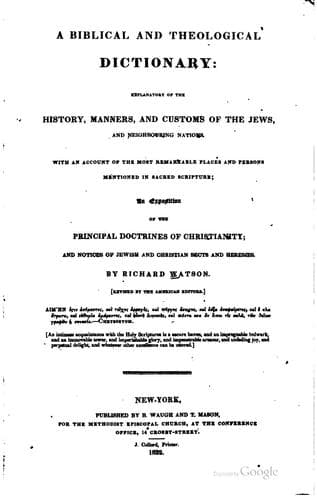
A Biblical and Theological Dictionary: explanatory of the history, manners, and customs of the Jews, and neighbouring nationsWatson, Richard
Religion
A Biblical and Theological Dictionary: explanatory of the history, manners, and customs of the Jews, and neighbouring nations
Watson, Richard
Bible -- Dictionaries; Theology -- Dictionaries
Cicero, likewise, speaking of himself, in Pison. c. 9, tom. vi, p. 187,
uses this allegorical language: “Nor was I so timorous, that, after I
had steered the ship of the state through the greatest storms and waves,
and brought her safe into port, I should fear the cloud of your
forehead, or your colleague’s pestilential breath. I saw other winds, I
perceived other storms, I did not withdraw from other impending
tempests; but I exposed myself singly to them for the common safety.”
Here the state is compared to a ship, and all the things said of it
under that image, are expressed in metaphors made use of to denote the
dangers with which it had been threatened. We have also a very fine
example of an allegory in Psalm lxxx; in which the people of Israel are
represented under the image of a vine, and the figure is supported
throughout with great correctness and beauty. Whereas, if, instead of
describing the vine as wasted by the boar from the wood, and devoured by
the wild beasts of the field, the Psalmist had said, it was afflicted by
Heathens, or overcome by enemies, which is the real meaning, the
figurative and the literal meaning would have been blended, and the
allegory ruined. The learned Bishop Lowth, _De Sacrâ Poesi Hebræorum,
Præl._ 10, 11, has specified three forms of allegory that occur in
sacred poetry. The first is that which rhetoricians call a continued
metaphor. When several metaphors succeed each other, they alter the form
of the composition; and this succession has very properly, in reference
to the etymology of the word, been denominated by the Greeks αλληγορια,
an allegory; although Aristotle, instead of considering it as a new
species of figure, has referred it to the class of metaphors. The
principle of allegory in this sense of the term, and of the simple
metaphor, is the same; nor is it an easy matter to restrict each to its
proper limit, and to mark the precise termination of the one, and the
commencement of the other. This eminently judicious critic observes,
that when the Hebrew poets use the congenial figures of metaphor,
allegory, and comparison, particularly in the prophetic poetry, they
adopt a peculiar mode of doing it, and seldom regulate the imagery which
they introduce by any fixed principle or standard. Not satisfied with a
simple metaphor, they often run it into an allegory, or blend with it a
direct comparison. The allegory sometimes follows, and sometimes
precedes the simile: to this is added a frequent change of imagery, as
well as of persons and tenses; and thus are displayed an energy and
boldness, both of expression and meaning, which are unconfined by any
stated rules, and which mark the discriminating genius of the Hebrew
poetry. Thus, in Gen. xlix, 9, “Judah is a lion’s whelp;” this metaphor
is immediately drawn out into an allegory, with a change of person:
“From the prey, my son, thou art gone up,” that is, to the mountains,
which is understood; and in the succeeding sentences the person is again
Public-domain text, read in full here on John Shaqi.
Reviews
Reviews
No reviews yet
Be the first to share your thoughts on this work.
Elsewhere in the archive
Join the Discussion
Join the discussion
Sign in to leave a comment or review.
Sign InorCreate an account